I first blogged about this property in 2012 when it was inexpensive rental housing. The original post is here.
This property located along the Guadalupe has now been restored and is known as River Trail Cottages. I am pleased to see this happen and hope more people will find ways to use some of the older buildings around the area in innovative ways.
Showing posts with label Water Street. Show all posts
Showing posts with label Water Street. Show all posts
Friday, July 28, 2017

Tuesday, July 18, 2017
Henry Noll Homestead
This antique house is currently for sale and needs loving restoration. I hope a buyer will be found who values it for its history and architecture.
NOTE: This is not my home. I just like this house, plus its history and architecture are similar to my home's.
NOTE: 22 Aug 2017: This house has a new owner who plans to restore it.

 This graceful 19th century Victorian home is the Henry Noll homestead. Originally located at 909 Water Street, at the foot of Washington Street in Kerrville, it now sits atop Deer Park Lane about four miles south of town. It was moved to its current location in 1983, one of many homes in Kerr County that have been saved by relocation.
This house appears on the first Sanborn Fire Insurance map for Kerrville, drawn in 1898, so we know for certain it is at least 120 years old. I believe it is older--perhaps a dozen years older. I have attached links to the 1898 and 1930 maps.
You will also see the 1898 and 1930 house footprints on this page.
On November 2, 1888, Christian Dietert sold a lot of land to Henry Noll for $300. Other lots of land nearby were selling for about $100, so either there was already a house on the lot, or Noll paid a premium for the location on the river. If indeed there was a house on the property, Christian Dietert MAY have built it. He operated a grist mill and saw mill next door.
Henry Noll operated a general store on Water Street near his home.
After he passed away in 1926 his son, Henry Noll, Jr. gave this house and the lot it sat on to his sister Elisabeth Johnston, who was married to Charles H. Johnston. He died in 1930.
Their son Charles H. Johnston, Jr. married Josphine Fawcett on September 8, 1936. Surrounded by commercial creep, they moved to 345 West Water Street in 1939. The Water Street location must have been lovely once. I found this comment in the March 23, 1939, Kerrville Mountain Sun, "Wouldn't you just love to have a bedroom like the one in the old Johnston home on Water Street, where the plum trees in full blossom completely surround the bay windows." You can see the bay window in the photo above.
In May 1941 Charles A. and Mary Reiter bought the property from the Johnstons and lived here until at least 1977. It was convenient to their auto sales and service business next door. By 1980 it sat vacant along with two neighboring properties owned by Notre Dame Catholic Church and was moved in 1983. Today 909 Water Street is a parking lot. I am so grateful though that someone found this house worth saving.
NOTE: This is not my home. I just like this house, plus its history and architecture are similar to my home's.
NOTE: 22 Aug 2017: This house has a new owner who plans to restore it.


This house appears on the first Sanborn Fire Insurance map for Kerrville, drawn in 1898, so we know for certain it is at least 120 years old. I believe it is older--perhaps a dozen years older. I have attached links to the 1898 and 1930 maps.
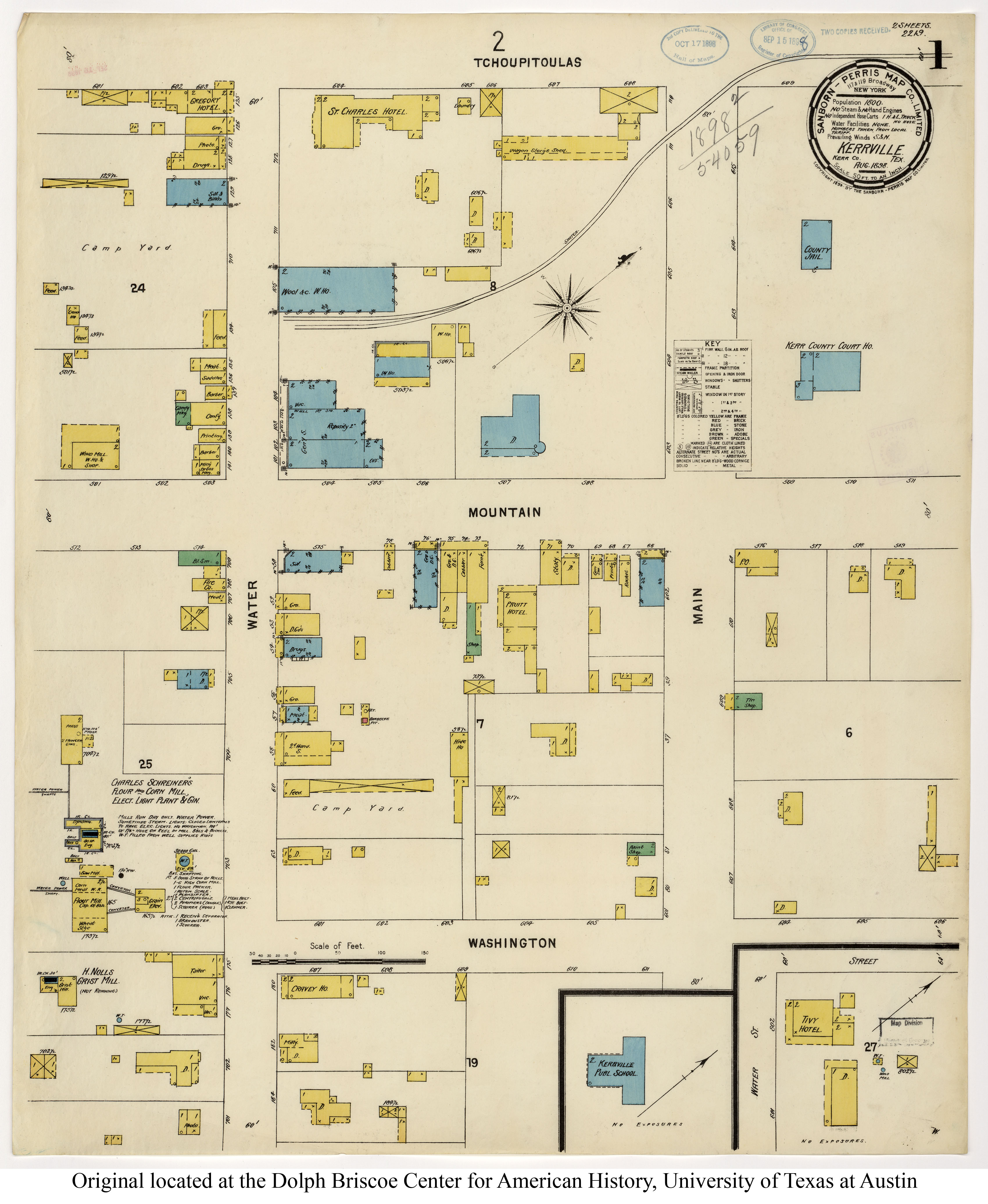

You will also see the 1898 and 1930 house footprints on this page.
On November 2, 1888, Christian Dietert sold a lot of land to Henry Noll for $300. Other lots of land nearby were selling for about $100, so either there was already a house on the lot, or Noll paid a premium for the location on the river. If indeed there was a house on the property, Christian Dietert MAY have built it. He operated a grist mill and saw mill next door.
 |
| 1898 footprint |
Henry Noll operated a general store on Water Street near his home.
After he passed away in 1926 his son, Henry Noll, Jr. gave this house and the lot it sat on to his sister Elisabeth Johnston, who was married to Charles H. Johnston. He died in 1930.
Their son Charles H. Johnston, Jr. married Josphine Fawcett on September 8, 1936. Surrounded by commercial creep, they moved to 345 West Water Street in 1939. The Water Street location must have been lovely once. I found this comment in the March 23, 1939, Kerrville Mountain Sun, "Wouldn't you just love to have a bedroom like the one in the old Johnston home on Water Street, where the plum trees in full blossom completely surround the bay windows." You can see the bay window in the photo above.
 |
| 1930 footprint |
In May 1941 Charles A. and Mary Reiter bought the property from the Johnstons and lived here until at least 1977. It was convenient to their auto sales and service business next door. By 1980 it sat vacant along with two neighboring properties owned by Notre Dame Catholic Church and was moved in 1983. Today 909 Water Street is a parking lot. I am so grateful though that someone found this house worth saving.
Thursday, October 3, 2013
1312 Water Street
 The original address for this house was 1212 Water Street. The streets in this area were renumbered about 1929.
This house at 1312 Water Street has some characteristics that have caused me to think this might be a 19th century house. However, continued research indicates that it is more likely this was built by Ben Davey sometime between 1910 and 1914. Here's my reasoning:
The legal description of this property is Block 10, Lot 17, Tivy Addition. On July 31, 1907, Sid Peterson sold lots 9 and 10 for $525 to J. H. Chapman. On Oct 16, 1907, J. H. and Ida Chapman sold lots 9 and 10 for $550 to Oscar P. Garrett, an average of $225 per lot.
Oct February 25, 1910, Garrett sold these two lots to Miss Mabel Grace Davey for $600. At the time she was a 23-year-old schoolteacher at Tivy. On June 10, 1914, she married Robert B. Knox.
On January 31, 1920, R. B. and Mabel Knox sold just lot 10, the one this house stands on, to John F. and Visa Surber for $600. Note that the value of the property had doubled in the intervening ten years. This suggests that the house was built in that time period.
 | |
| ca 1932. Courtesy, Kerr County Historical Commission Collection |
Ben Davey was at one time in partnership with Bruno Schott, veteran Kerrville builder. Many of the early buildings in the area were constructed by the firm.
John F. and Visa Ann Surber, the next owners, and their heir Annie Rotge together owned the house for fifteen years. He had been a farmer but by 1920 he was no longer working.
In 1936 Charlie Hansen, an employee at the VA Hospital, purchased it. He died in 1961, but his family owned it another six years until 1967. The Hansens owned the property the longest--31 years.
Over the next dozen years there were four separate owners. It continued to be residential property until D. K. Livingston bought it in 1979. Liquidation Outlet opened here at the end of that year--the first of a series of small businesses located here ever since.
Sunday, August 25, 2013
720 Water Street

The report on this new project appeared in the February 19, 1948, Kerrville Mountain Sun.
"A Ladies Ready to Wear structure will be built on Water Street, adjoining the present store, completely filling the 47 foot space now used as a parking lot. This building will be 100 feet deep, and will be of one story construction. It will have the same type of architecture as the present building with cut stone top and a thoroughly modern front."
The aforementioned parking lot was laid on top of the old rails for the spur line that ran to the wool warehouse. In April 1948, while it was under construction, the adjoining wool warehouse was destroyed by fire. The warehouse was rebuilt, but that must have added an interesting twist to the new construction.
At the same time this building was going up the grocery store on Earl Garrett was enlarged adding, according to the newspaper, "36 feet at the side, and made 20 feet longer." The total space for the expanded grocery was 8000 square feet.
Read about the Schreiner Cash and Carry Grocery here.
On the day the expanded grocery opened in August 1948 there was a live radio broadcast from a Fredericksburg station as well as food giveaways.
I never had the opportunity to shop at Schreiner's, but I was told that this was always the Ladies' Ready to Wear department until the store closed a few years ago.
Sunday, July 28, 2013
Bear on the Loose
This is one of those stories that's just worth sharing.
On September 1, 1896, Henke Bros. City Meat Market opened at 816 Water Street. They had purchased the business from Karger Bros. With the business came a pet black bear who was chained outside the back door. He managed to get loose and went for a stroll, first checking out the rear door of a drug store next door. The owner pulled out his shotgun and took potshots at the bear. Enraged, the creature ran down Mountain Street (now Earl Garrett Street) chasing everyone off the street before turning into the Chas. Schreiner store.
Here is the story as told by the September 2, 1936, Kerrville Times on the 40th anniversary of the event: Bear Invades Store in City And Is Slain
Excitement Rampant in Kerrville--in Good Year 1896
On September 1, 1896, the staccato bark of carbines and the roar of shotguns disturbed the calm of Kerrville, then a ... town of some 1,200 souls. The big excitement was created by a black bear that "went on the loose", and among other overt acts, disrupted a red-hot argument over the McKinley-Bryan presidential campaign, then in full swing.
The thrilling events of that day 40 years ago were particularly impressed upon the mind of A. W. Henke. The young man on that very day has entered the business field in Kerrville, buying the City Meat Market from Karger Bros. Among the appurtenances in the market transfer was one pet black bear. The bear was kept chained n the rear of the shop. Dissatisfaction over his new ownership, the crisp autumn air, or something else, brought an atavistic mood to bruin; in some manner he broke his leash and started out for a stroll.
The free bear nosed around the rear door of a drug store, operated by W. E. Stewart where the Rock Drug Store now is located. Stewart took a pot shot with his shotgun, sending the animal into a rage. The bear darted out into Mountain Street, now Earl Garrett Street, clearing that thoroughfare of all pedestrians and frightened horses tied to hitching racks.
Next the berserk bear dashed into the side door of Captain Chas. Schreiner's store and gave a ferocious growl ...
Employees of the store hastily armed themselves with guns and ammunition from the store's stock and the bombardment opened. Up and down Water Street people thought the Schreiner Bank was being rustled by bandits. The bank then was in a small rock building on the present site of Schreine'rs dry goods department.
Volley after volley from rifles and shotguns riddled ... valises and derby hats on the counter, while dishpans were converted into sieves by buckshot before the bear slumped on the floor; dead.
Reminiscing Monday on the fortieth anniversary ... A. W. Henke recalled that his newly acquired pet bear was butchered and retailed for over the counter for 12 1/2 cents a pound--the best bear meat ever to be sold in West Texas.
Concerning the same event, L. A. Schreiner, who was a boy at the time, was watching the Italian stonemasons work on the exterior of the Chas. Schreiner mansion, his family home, when the bear got loose. Some sixty years later, remembering the event he recalled the bear "got loose, and came lumbering down the street and pandemonium ensued. The terrified Italians climbed the trees like monkeys."
On September 1, 1896, Henke Bros. City Meat Market opened at 816 Water Street. They had purchased the business from Karger Bros. With the business came a pet black bear who was chained outside the back door. He managed to get loose and went for a stroll, first checking out the rear door of a drug store next door. The owner pulled out his shotgun and took potshots at the bear. Enraged, the creature ran down Mountain Street (now Earl Garrett Street) chasing everyone off the street before turning into the Chas. Schreiner store.
Here is the story as told by the September 2, 1936, Kerrville Times on the 40th anniversary of the event: Bear Invades Store in City And Is Slain
Excitement Rampant in Kerrville--in Good Year 1896
On September 1, 1896, the staccato bark of carbines and the roar of shotguns disturbed the calm of Kerrville, then a ... town of some 1,200 souls. The big excitement was created by a black bear that "went on the loose", and among other overt acts, disrupted a red-hot argument over the McKinley-Bryan presidential campaign, then in full swing.
The thrilling events of that day 40 years ago were particularly impressed upon the mind of A. W. Henke. The young man on that very day has entered the business field in Kerrville, buying the City Meat Market from Karger Bros. Among the appurtenances in the market transfer was one pet black bear. The bear was kept chained n the rear of the shop. Dissatisfaction over his new ownership, the crisp autumn air, or something else, brought an atavistic mood to bruin; in some manner he broke his leash and started out for a stroll.
The free bear nosed around the rear door of a drug store, operated by W. E. Stewart where the Rock Drug Store now is located. Stewart took a pot shot with his shotgun, sending the animal into a rage. The bear darted out into Mountain Street, now Earl Garrett Street, clearing that thoroughfare of all pedestrians and frightened horses tied to hitching racks.
Next the berserk bear dashed into the side door of Captain Chas. Schreiner's store and gave a ferocious growl ...
Employees of the store hastily armed themselves with guns and ammunition from the store's stock and the bombardment opened. Up and down Water Street people thought the Schreiner Bank was being rustled by bandits. The bank then was in a small rock building on the present site of Schreine'rs dry goods department.
Volley after volley from rifles and shotguns riddled ... valises and derby hats on the counter, while dishpans were converted into sieves by buckshot before the bear slumped on the floor; dead.
Reminiscing Monday on the fortieth anniversary ... A. W. Henke recalled that his newly acquired pet bear was butchered and retailed for over the counter for 12 1/2 cents a pound--the best bear meat ever to be sold in West Texas.
Concerning the same event, L. A. Schreiner, who was a boy at the time, was watching the Italian stonemasons work on the exterior of the Chas. Schreiner mansion, his family home, when the bear got loose. Some sixty years later, remembering the event he recalled the bear "got loose, and came lumbering down the street and pandemonium ensued. The terrified Italians climbed the trees like monkeys."
Wednesday, May 15, 2013
Where on Water Street is this?
Hello loyal readers,
Today I'm asking for your help. This photo appeared in the March 11, 1971, Kerrville Mountain Sun.
 As you may be able to read in the caption, it is supposed to be Water Street in Kerrville in 1895. The building with the balcony in the center of the photo may be Pampell's. However, the balcony on Pampell's covered the entire front of the building. This one appears too short. It may just be the perspective though, or it may be that the photo is damaged. I have looked at the Sanborn map for 1898 and tried to match up buildings with second floor balconies with what appears in this photo. Notice there seems to be a building roof, possibly a balcony, on the left in the photo.
The intersection of Water Street and Tchoupitoulas (Sidney Baker) Street appears to be the best choice. If this is Pampell's, then the white frame building in the background is the building that now houses Co-Nexus. Take a look for yourself at the Sanborn map and see what you think. If you are unfamiliar with these, a 1 indicates a one-story building, a 2 indicates two stories. This clip from the map is centered on Water Street at Mountain (now Earl Garrett). Sidney Baker is at the top, Washington at the bottom.
I welcome your feedback.

Today I'm asking for your help. This photo appeared in the March 11, 1971, Kerrville Mountain Sun.
As you may be able to read in the caption, it is supposed to be Water Street in Kerrville in 1895. The building with the balcony in the center of the photo may be Pampell's. However, the balcony on Pampell's covered the entire front of the building. This one appears too short. It may just be the perspective though, or it may be that the photo is damaged. I have looked at the Sanborn map for 1898 and tried to match up buildings with second floor balconies with what appears in this photo. Notice there seems to be a building roof, possibly a balcony, on the left in the photo.The intersection of Water Street and Tchoupitoulas (Sidney Baker) Street appears to be the best choice. If this is Pampell's, then the white frame building in the background is the building that now houses Co-Nexus. Take a look for yourself at the Sanborn map and see what you think. If you are unfamiliar with these, a 1 indicates a one-story building, a 2 indicates two stories. This clip from the map is centered on Water Street at Mountain (now Earl Garrett). Sidney Baker is at the top, Washington at the bottom.
I welcome your feedback.
Thursday, January 31, 2013
631 Water Street
 |
| Early 2012 photo |
I first wrote about this building on June 19, 2012. At that time I titled it "Ward's Funeral Home" and said it was erected no later than 1918. While that is not incorrect, I have learned much more of the history of this building. Rather than extensively edit that post, I am deleting it and posting this instead, mostly because I want to be sure my loyal readers see this updated information.
The startling results of additional research show that this nondescript stuccoed commercial building is one of the ten oldest buildings in downtown Kerrville.
The story of this building begins in the 19th century. On Feb 3, 1891, Charles Schreiner sold the 44x100 ft land this building sits on to William K. Sharpe "of Dover, New Hampshire" for $2000. [Sharpe was a wool buyer with Sawyer Woolen Mills of Dover.] Since vacant lots were generally going for about $75 each, there must have been a building here. I am still working to discover when the building actually went up, but it obviously was finished no later than January 1891. Most likely Charles Schreiner was responsible for having it built.
 |
| Building after 1929 remodeling |
 |
| Photo here is of Pampell's. 631 Water St. building is visible at far right in this undated photo. |
Then in August 1924 the Kerrville Mountain Sun reported that the building had been undergoing a remodeling for the past several months, that more rooms had been added by removing part of the former building and adding on.
In 1929 Sid Peterson, for whom the hospital is named, purchased the building and business from John H. Ward and N. B. Smith and completely remodeled it. After the remodel the business was sold to Edgar H. Fatheree and his father-in-law, Charles Neidert, and was renamed the Kerrville Funeral Parlor. In 1932 there was a corporate reorganization and the business name changed to Peterson Funeral Home. The Peterson Funeral Home operated about two years before closing its doors. The chief employees of the business established a new partnership called Fatheree Antony Funeral Parlor at 205 Water Street.
By early 1935 this building was being called the Peterson Building and since that time has housed a number of small business offices.
1704 Water Street

A. C. Schreiner sold lots 5 and 6 of block 13 in the Tivy Addition to Thomas Frayne in May 1925.
Then in March 1927 Frayne sold the lots to Thomas C. Staley for $750. Staley was an architect from California and was responsible for remodeling the Dixie Theater. On the 1930 census though he was listed as a proprietor of a filling station at the corner. In March 1927 Staley began work on a tourist village in Water Street near the intersection of the Medina Road. This building probably went up about that time.The description of the project (10 two-room cottages and later adding a store, apartment house, and lunchroom) does not match what is on this lot in 1930. It appears from the 1930 Sanborn map that he put up a retail building and perhaps two cottages. These were in addition to the gas station and residence which I blogged about earlier.
When Staley and his wife went to California for several months in 1928 on an architecture job, he rented the "Staley village" and store to G. M. South. One year later South list a small grocery and lunchroom near Medina Road for sale, probably the same. The Staleys did eventually return.
The next few years are quiet. Then, in January 1935, the Kerrville Mountain Sun reported that Mr. and Mrs. W. E. James, "formerly of the Tasty Coffee Shop 1704 Water Street" had taken over management of the Kerrville Municipal Golf Course and Dining Room.
Six week later, March 7, 1935, the following appeared in the Kerrville Mountain Sun
"New Restaurant Now Open On Water Street. A new business enterprise, 'Aunt Jean's' Restaurant and Delicatessen, has been opened at 1704 Water Street by Mrs. W. L. Harcus. ... The interior ... has been rearranged and redecorated."
In August 1938, Edson's Kerrville Kabinet Shop moved into this building, remembered later as badly neglected. In 1941 the woodworking department moved into the former gas station at 1700 Water Street. Edson's furniture business has been here ever since.
Friday, January 25, 2013
Kerrville Recreation Building
 This building at 1708/1712 Water Street, part of the Edson's Kerrcrafters complex, was built and financed by Louis A. Schreiner in 1946 as a bowling alley. The owner of the business was Sully S. Woodland, the manager H. S. Roe.
The Kerrville Mountain Sun of August 29, 1946 reported that "Sully's Bowling Alley" would open Saturday, September 7.
"The owner and manager of the center are optimistic as to the future of the sport in Kerrville, and promise a clean and up-to-date recreational center. Bowling is for all ages, and no matter how much of a novice the player is, he enjoys participation in his very first game."
It didn't last long. This 10-lane bowling center was replaced in March 1948 by Sully Woodland Motors, a Lincoln and Mercury auto dealership.
In April 1954 the building returned to an entertainment center when Doug Gleason opened a new roller skating rink here. The newspaper reported "Gleason said the rink would be named in a contest and the place hopes to provide clean wholesome entertainment for the entire family." I can find no record of the results of a contest. It is simply referred to as the Kerrville Skating Rink in news stories and advertising. At least occasionally on Friday and Saturday nights it also served as a dance floor.
This was a short-lived business. In September 1955 the maple flooring was pulled up and offered for sale. The next month it was announced that the George Faber Co., a furniture upholstery company, was moving his business from San Antonio here.
The Junk Jungle was here for a few months in 1960. It was then taken over by its current owner, Edson's Kerrcrafters.
Friday, December 28, 2012
217 W. Water Street
 |
| 2011 |
The first record of a house in the written record is in the 1930 census. That same year Otto Bernhard gave the property to his wife Ottilia for "love and affection" and she became the owner.
According to his 1958 obituary, Otto Bernhard, a native of Gillespie County, had lived in Kerrville 38 years, so he arrived about 1920. In addition to being the family home, Bernhard ran a trucking company from this property, specializing in hauling dirt and gravel.
The Bernhards lived here many years.
The house was sold in 1962 to Dr. John Redden for his veterinary practice. Later Dr. Joseph Kitzman took over the practice. It has been a commercial property since.
 |
| 1932. Photo from the Kerr History Center collection. |
Sunday, December 23, 2012
No Curb Service


 |
| Here is the building with the sign when it was outside. |
The sign references two old businesses: the Modern Beauty Salon and Campbell's Cafe. When I first saw this I thought the reference was to curb service being offered (or not) at the beauty salon! That was certainly an intriguing idea, one difficult to picture. I now know that Campbell's was a cafe that originally offered curb service. At some point curb service was eliminated at the cafe, which is probably when "No Curb Service" was added and the word "Curb" painted over.
As you can see in the black and white photo, this sign used to be on the outside of the Modern Beauty Salon building. In the same photo you can see a vacant lot next to the Modern Beauty Salon building. That vacant lot once was the parking lot and part of the curb service area for Campbell's.
Mr. Bruce O. Long opened the Modern Beauty Salon at 617 Water Street on Saturday, October 23, 1937, in the "new Parsons Building". The business changed hands a few years later, when Mae Walz purchased the business and added a Merle Norman Studio. (The building address had changed but it's still the same building.)
In July 1949, Rae Fergason, Ann Hammock and Eloise Brown announced they were "glad to see their old friends and to make new ones at the Modern Beauty Salon."
In October, 1949, it advertised late night hours, an unusual idea at the time. "The Modern Beauty Salon announces a special night service for BUSINESS WOMEN and NURSES By appointments only on Wednesday nights until 9 p.m. 617 Water St."
The business continued until at least 1950 according to the city directory.
The next business in the space may have been Howard Wilson's print shop. If so, it wasn't here very long. The only record I can find of this print shop is in a news story about Paul McDonald, Co. reporting that he bought the printing plant of Howard Wilson in 1951. Four years later McDonald moved his shop from 617 Water Street to a new building in the 500 block of Sidney Baker Street. J. Marvin Hunter's print shop was apparently next, followed by Herring Printing in 1965.
As for Campbell's Cafe, whose name occupies the lower part of the sign, the Kerrville Mountain Sun July 10, 1928, ran the following news item, "Campbell & Son of San Antonio have opened a drive-in hamburger and drink stand on Water Street in the tile construction building erected for them by Bert Parsons. Facilities for curb service are available, as well as parking space within the enclosure housing the building, and tables and seats have been arranged under outdoor lights for the convenience of those who desire to be out in the open while partaking of refreshments. " The cafe moved down the street from 611 to 307 Water Street in 1932, then four years later returned to the original location.
The building the cafe occupied was torn down a while back. By 1948 its old parking lot was replaced with a commercial building, and thus the reason the old sign is now inside.
Tuesday, December 11, 2012
Kerrville Tourist Cottage Camp
 Constructed in 1928, these cottages in the 1700 block of Water Street were originally known as Kerrville Tourist Cottage Camp and later as Kerrville Tourist Courts. There once were more cabins than today.
Richard Holdsworth purchased the property in 1927 from the Furman Co., Inc. for $1500. He constructed the cottages, then in September 1928 he sold the property to Frank Marek for $6000 who opened the Kerrville Tourist Cottage Camp. In 1930 Frank Marek sold the property to Harry J. Chafee and his wife.
The Chafees were the owners at the time of the 1932 flood. The July 7, 1932 Kerrville Mountain Sun described what happened to these cottages. "As a whimsical child would move toy houses from one village to another, the flood clutched up several amber-orange cottages from the Kerrville Cottage Camp at 1717 Water Street, and deposited them a block away on the grounds of Bass Courts. In contrast to the white and green cottages there, the flood-shifted cabins were easily seen."
Eighty years later the color scheme is about the same!
I do not know if the cabins affected were torn down or returned to their original locations.
In 1933 Mrs. Chafee announced the opening of the Lone Oak Sandwich Shop at the Cottage Camp. It was advertised as under new management, but I haven't found a mention of an earlier restaurant here.
No longer operating as a motel, these units today are rental apartments.
UPDATE: In July 2017 this property was restored and reopened as River Trail Cottages, short term rentals along the Guadalupe.
Sunday, November 25, 2012
Mosty's Garage
 |
| November 2012. Tricky getting a photo without cars at a busy intersection. |
 |
| Edited to enhance details |
March, 1926, Thomas Frayne sold the property to L. A. Leinweber for $1,500. Three and a half years later, in November, 1929, L. A. Leinweber sold the property to Mosty for $4,500. That's quite an increase in value in 3 1/2 years. There must have been a substantial building on the property.
On February 3, 1930, after a remodeling, Mosty moved his business one final time. The garage has been here ever since.
The Kerrville Mountain Sun of February 6, 1930, made this report, "This property was recently purchased by the garage firm and remodeled into a modernly equipped service station and general repair department. For several years Mosty's Garage was located at 111 Water Street at the north end of Town Creek bridge. "
I am not certain of the exact age of the buildings, but we know they were erected some time between 1924 and 1929. The 1924 Sanborn map shows a house on this property, and in 1930 the buildings we see today were here, both the old gas station and the hollow tile service building behind. We can assume Mosty didn't erect either building since the newspaper reported only that he had remodeled.
I have not been able to absolutely determine what business was here before Mosty's but I found an advertisement for the "St. Louis Fur Buyer, Water and Lemos Sts. Dealer in Furs, Poultry and Eggs. Dressed Poultry at all Times" in the Kerrville Mountain Sun of December 20, 1928.
Since at the four corners of this intersection in 1930 were Haines funeral home, two residences, and a commercial building, it is highly likely that the business in this space immediately before Mosty's moved in was the fur buyer.
Saturday, November 10, 2012
1400 Water Street
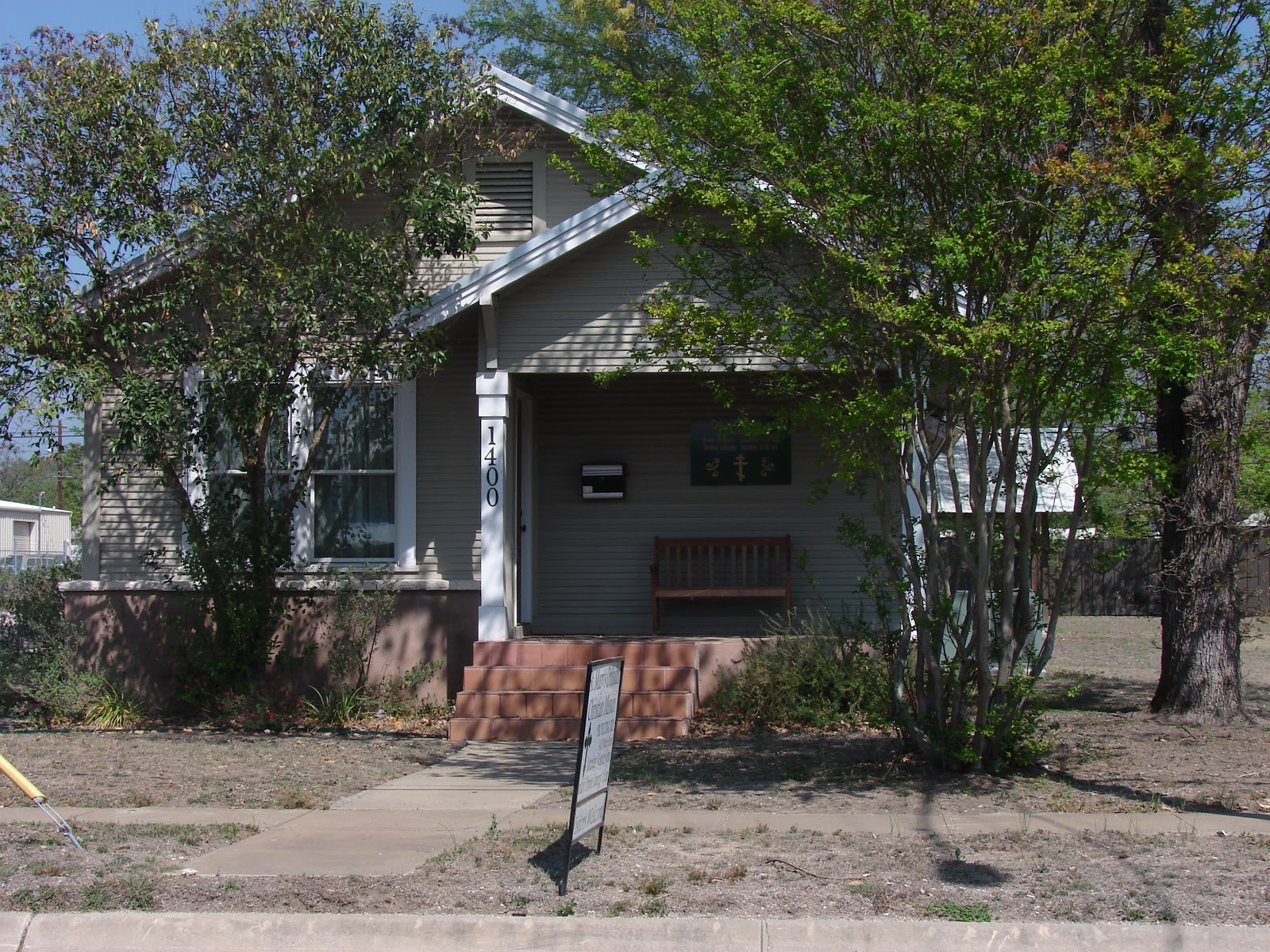
Today this house on the corner of D Street and Water Street has the address of 1400 Water Street, but originally it was 1300 Water Street. The address changed sometime between 1924 and 1927, exact date uncertain.
In September 1922, Harry Gordon and wife sold the lot this house sits on to Mrs. Dora Brown for $800. After checking prices of surrounding lots I found some lots selling for as little as $75, so I believe there may have been a building on the property. The 1924 Sanborn fire insurance map shows a small store building with a porch. The porch overlies the street right-of-way. (I'm having trouble getting the Sanborn map to load properly. If I fix it, I'll add the map so you can see what I mean.)
In December 1923, she sold the business to H. A. Hartmann and P. J. Baethge. They went out of business eight months later in July 1924. Mrs. Brown must have begin operating a new store, because the following item appeared in the May 1, 1924, Kerrville Mountain Sun.
Noll Believes in Advertising.
Henry Noll of the Noll Stock Co. believes in advertising and never misses a chance to boost his business but he is undergoing quite a lot of joshing over one of his latest advertising stunts.
Several years ago when the Noll Stock Co. put on auto delivery service they had a practically new horse drawn wagon left on their hands. Mrs. Dora Brown, who recently opened a grocery in the lower part of the city, offered to buy the wagon.
Henry, sensing an opportunity for boosting his business, offered to sell the wagon to her at a reduced figure if she would permit him to carry an ad on the side of the wagon. She agreed, and the trade was made. When the wagon appeared on the streets on one side it bore the legend, "It Pays to Trade at Noll's". But on the other side in glaring letters was the additional information: "You Can Buy Cheaper at Mrs. D. Brown's."
The county deed book records on May 21, 1925, a sale of land from R. E. Brewer to Mrs. Dora Brown in the amount of $1675 mentions a house on the land. She also gets several pieces of furniture: 1 dining table, round, and 6 chairs, 1 cane rocker, 2 home made walnut rockers; 1 dresser, 1 center table, 1 iron bed, one mattress, one coal oil stove and oven and one heating stove.
Then, on July 30, 1925, the following item appears in the Kerrville Mountain Sun. Note that the brothers combined two store buildings they owned. Is this the same building? Was this house actually created from combining two retail buildings? Were they living behind the store?
Brown Brothers Enlarge Grocery
The Brown brothers have just competed the doubling of the amount of floor space occupied by their grocery store on lower Water Street near Lakeside Park. Two store buildings owned by them have been moved together and the walls torn out between, making one large room for the display of their wares.
The mother of the boys, Mrs. Dora Brown, started the store about two years ago, but has now turned business over to her sons, who recently closed out their business in Boerne. Names of the proprietors are I. M. and S.A. Brown, and they are wide-awake, progressive merchants.
December 1926, Sam A. Brown bought the business from his brothers and on December 1 opened the store as a cash and carry. Two months later Alois Remschel opened a tire and accessory store in the building "former occupied by Brown Bros Grocery". He was still in business in July 1927, yet during this time H.E. Lucas opened the Lucas Cash Grocery in April 1927. This building must be at today's 1400 Water. The "old" 1400 would be 1500 today, and in 1930 there was no building at 1500 Water.
The following is from the May 5, 1927, Kerrville Mountain Sun.
Extension to the Lucas Cash Grocery. H. E. Lucas, who opened up a cash grocery store at 1400 Water Street recently, is engaged this week in making an enlargement to his store. Fixtures are being installed in a room adjacent to the store and progress in installing an up to date delicatessen shop, where he will be able to furnish to the public a complete line of salads, lunch meats, sandwiches, pastries and other picnic or luncheon delicacies.
In the 1930 and 1940 censuses this building was occupied as a rental residence, Avislena Patterson and family being here in 1930, and Wayne T. Sibson and family in 1940. It continued as a private residence until sometime after 1960. A day care center operated here 2000-2006. The most recent occupant was the Most Holy Theotokos Mission of the Orthodox Christian Church.
I have much more on this house, chain of title, newspaper mentions, and census data which I won't bore you with, but much of it is conflicting. Do any of my readers know more about this house?
Saturday, October 20, 2012
1700 Water Street
 This building is the third of three former gas stations at the intersection of Water and G Streets. It is also the mostly easily recognizable as a former gas station.
This building, home to Edson's Kerrcrafters, was erected in August 1932 as a Gulf filling station. It replaced an earlier gas station and garage that was destroyed by fire in June of 1932. That station had been operated by Roy Troutner.
At the time of the fire the building was owned by Mrs. P. Ethridge, the land by T. C. and Minnie Staley.
The new one-story frame filling state and auto repair shop was leased to brothers M. P. and Jack Woodward, who ran the business for a while.
Edson's Kerrcrafters was established in 1938 at 1704 Water Street. Minnie Staley sold this property next door in July 1943 to A. B. Edson and wife who then converted the gas station to a furniture workshop. The building, expanded over the years, has housed Edson's Kerrcrafters ever since.
At the time of the fire the building was owned by Mrs. P. Ethridge, the land by T. C. and Minnie Staley.
The new one-story frame filling state and auto repair shop was leased to brothers M. P. and Jack Woodward, who ran the business for a while.
Edson's Kerrcrafters was established in 1938 at 1704 Water Street. Minnie Staley sold this property next door in July 1943 to A. B. Edson and wife who then converted the gas station to a furniture workshop. The building, expanded over the years, has housed Edson's Kerrcrafters ever since.
Wednesday, October 17, 2012
1701 Water Street

This building at the corner of Water and G Streets has housed C. T. Robinett Paints since 1969, but originally it was a garage and filling station, one of three at this intersection.
J. C. Adrian and his wife had a home on the banks of the Guadalupe they called Live Oak Hill.
In 1926 they transferred the property to their son Morris, who then sold it to J. G. Cox. Cox was the local Texaco agent, who then erected this building. It was known as the Handy Stop Texaco. A gas station operated here for more than 20 years.
In 1946 Mr. and Mrs. Ned Harrel opened a barbecue stand at the rear of 1701 Water Street serving chickens, goats, and other meats, as well as iced watermelons. It does not appear have been there long, as only a few ads appeared.
In 1954 there was a secondhand store, which was only there a short time. For most of the next 15 years the building sat vacant until Robinett Paints opened in 1969. It has been expanded and remodeled several times since.
Sunday, October 14, 2012
1621 Water Street
Before the Sidney Baker Street bridge was constructed, the river crossing at G Street was heavily used, much more so than today. As a result there were once three gas stations at the corner of Water and G Streets. The intersection was also called at various times, and sometimes concurrently, "Water Street and Medina Road" and "Water Street and Turtle Creek Road". The fourth corner held the Caroline Courts tourist camp.
 The first mention I find in the newspaper of a service station at 1621 Water Street is November 11, 1926, when Linder's Garage "formerly Highway Garage" is mentioned. I don't know how much earlier the Highway Garage had been in business.
On November 25, 1926, the Kerrville Mountain Sun reported that "L. F. Linder, who for the past two months has conducted a filling station at the corner of Water Street and Medina, last week opened a completely equipped garage and service department in connection." Within two years, a lunchroom had opened in connection with the garage. You could have a meal while your car was being serviced.
The last mention of a service station here is in 1935 (although one may have continued longer). After that a series of cafes and taverns have been housed in this building. My personal favorite (because of a funny family story involving rabbit) was the Buff Cafe, which opened under new management in April, 1948, "Mrs. Lee C. Taylor, specializing in Pit Barbecue, Fried Rabbit, and Home Made Pies".
Today Mulligan's Pub is here.
Thursday, October 11, 2012
408 Water Street

 |
| ca 1988, Kerr County Historical Commission collection |
THIS POST HAS BEEN MODIFIED DUE TO NEW INFORMATION.
This house at 408 Water Street was surveyed for the Texas Historical Commission in 1973. At that time it was described as a "highly ornate Carpenter Gothic of the Late Victorian era." It was said to the "first frame ell-shaped Victorian cottage. " The description also indicates there was a rear addition, put on before 1973. The house was remodeled in September 1983.
I had speculated that this house may have been moved to this lot. My reasoning for why is below.
Thanks to Mary Lee Jobes Stewart, I have learned that this house was indeed moved. Her mother Alice Domingues Jobes said that the house was originally on the Louis Schreiner property (where the Butt-Holdsworth library is now). Mrs. Jobes remembered that the house was cut in two and part moved to this lot. After looking at Sanborn maps, I now know that it was next to the long building at 433 Water Street that is sometimes referred to at the old Schreiner bowling alley. That building was moved to 415 Clay in 201l, is now called the Dietert Mercantile, and is once again a retail building.
Read about it here:http://www.depotsquarekerrville.com/index.php/history/depot-square-history
 This house appears on the 1904 Sanborn map as a residential property. In front of it was the old Dietert Mercantile building. The house and store building are at the foot of Quinlan Street. Sometime around 1916 the house was moved to 408 Water Street so that a new addition could be put on the back of the Dietert Mercantile building. At this time the mercantile building became the Schreiner's private bowling alley and a rock fireplace was added.
I am still not sure of the age of this house, but it predates 1904, and is possibly as old as the 1884 Dietert Mercantile building.
******
Here is my reasoning for why I thought this house had been moved here:
In 1915 Charles Schreiner sold the lot this house sits on, and the adjoining one, to Dr. William Lee Secor, wife Hattie Secor, and W. L. Council for $550 (an average of $275 each). This price suggests these were vacant lots.
In 1920 Council and the Secors sold just the one lot where this house is to Dr. J. D. Jackson for $3000. The most reasonable explanation for the large increase in price is that a building now sat on the lot. Wm. L. Council was a builder and could have erected this building, however he had a distinctive style, one quite different from this house. In addition, by 1915 or so this Victorian style was fading in popularity.
******
The house has been a commercial property since 1984.
Monday, October 8, 2012
A Story of a Shared Wall: Grape Juice and the Rialto

Construction began on this retail building at 623 and 625 Water Street in late 1963. The Rose Shop, a florist, moved from 304 Main Street into 623 Water Street, the space now occupied by Grape Juice, in February 1964. The Rose Shop was here some 40 years.
The other half the building, 625 Water Street, now called Gather by Grape Juice, housed a number of retail shops over the years. This building replacing an old house that had seen much service as the home of many small businesses. You can see the corner of that house in the photo below.
 While at the time I write this most of the building is not quite 50 years old, a portion of it is. And that is really the story.
Between Grape Juice and the Herring Printing Co. is a parking lot which is the former site of the Rialto Theater, shown here. The outside wall of 623 Water Street that runs along the parking lot was originally part of the Rialto, erected in 1938. When the new building was erected, it was simply attached to the theater building instead of constructing a new wall. As a result, when the theater was taken down, this one wall survived. The former exterior portion of the wall of the theater now faces the interior of the restaurant and wine shop. Look carefully at the hollow tile wall of the theater. The next time you go to Grape Juice you will see the same blocks in the wall.
Today along the outside wall can be seen the outline of the stairs that went to the balcony--a reminder of the segregation era. During the unfortunate Jim Crow era of enforced segregation, the balcony was the only place in the theater blacks could sit to watch a movie.
The Rialto was demolished in 1974.
Saturday, September 29, 2012
1718-1720 Water Street

Constructed no later than winter of 1928, this building at the corner of Water and H Streets is currently vacant. It has had two different house numbers in its history--1718 and 1720 Water.
A commercial building with attached living quarters, the roofline of a small house can be seen.
In January 1928, Arthur K. Hammond and his wife sold this plot of land to J. R. Jennings. The first newspaper record of a building on this lot is in March 1928, when Sparkman's Kerrville Gulf Filling Station is mentioned in a newspaper ad. By May 1929, Florence Robinson, a widow, had taken over the business, which she called Sparkman Place.
The 1930 census shows that she rented the property at 1720 Water Street for $20 a month. Living with her were two sons, Bowman and Guy, as well as a boarder, James Trainer, proprietor of a filling station. This no doubt was the filling station she operated.
In October the same year the Kerrville Fish and Oyster Market opened here. The fish market may have been an adjunct to the gas station.
In September 1932 she bought the land that lay under her business from J. R. Jennings. The property was sold three years later and had several owners afterwards.
In early October, 1934, a young boy by the name of Gerald Eric Vallier, whose family then lived here, dashed into Water Street into the path of a moving car. He died of his injuries a few days later and was buried on his fourth birthday, October 10, 1934. Within about a year his parents moved to a house on Broadway.
Over the next three decades the property was offered for rent or sale several times, sometimes as a store and filling station with attached living quarters, and sometimes as a five room house with sleeping porch. It appears that during most of this time, the business operated as a corner store and filling station with the family living behind the store.
In 1965 Roy Pruneda made additions to the building and opened the Acapulco Restaurant, later known as El Azteca. The restaurant closed about 1993 and was followed by a series of other Mexican restaurants.
Its most recent use was the Bandidos Motorcycle Clubhouse, 2005-2006.
.
Subscribe to:
Posts (Atom)