Showing posts with label restaurant. Show all posts

Sunday, February 16, 2014

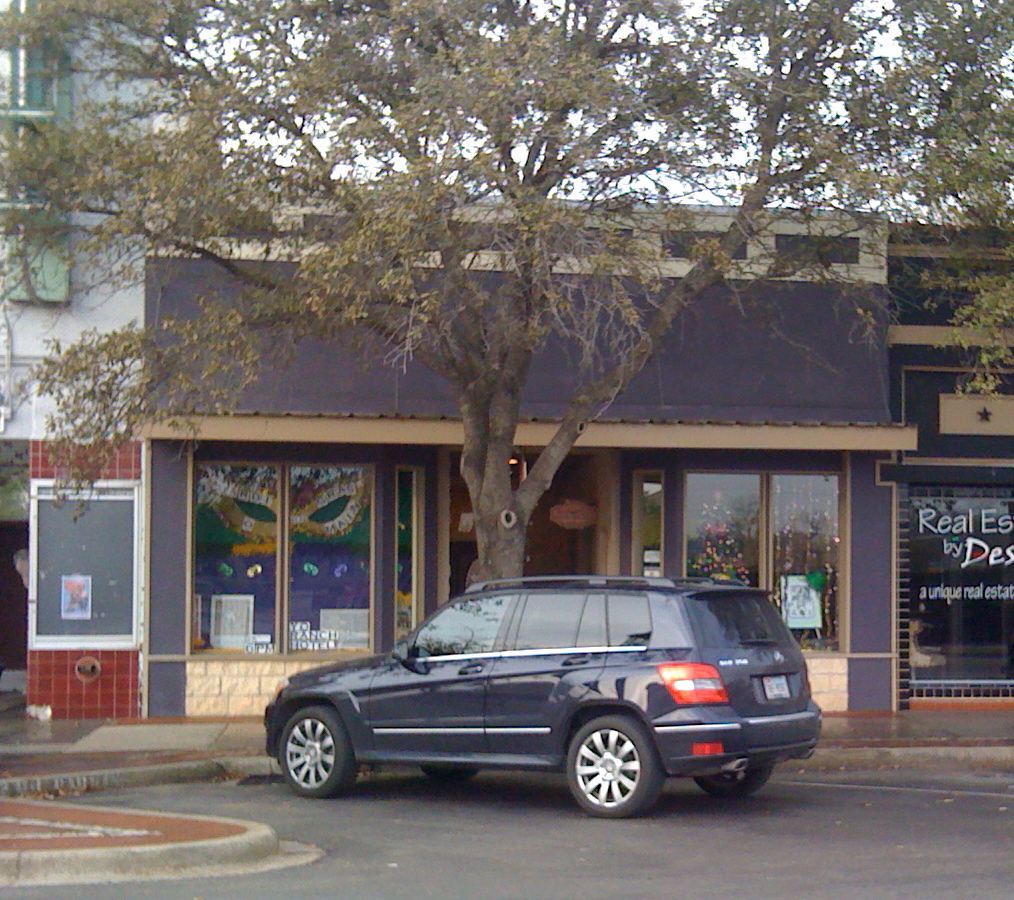
235 Earl Garrett Street

This small building at 235 Earl Garrett Street was built sometime between 1904 and 1910. It has a distinctive skylight, a feature I've not seen in any other local building of that period.
The Sanborn Fire Insurance maps show that in 1904 there was a frame building at this approximate location. By 1910 it had been replaced by this stone building and housed a jewelry store. In 1916 it was a jewelry and millinery shop.
There is a gap in the record between 1916 and 1925.

In January 1925 Isaac W. Van Hoozer purchased the dry good and grocery stock of bankrupt J. W. Burney's store on Schreiner Street and moved it to the building Van Hoozer owned on Earl Garrett, "next to the Kerrville Tailoring Company" according to the February 19, 1925, Kerrville Mountain Sun. Van Hoozer had remodeled and refinished the building and opened the store for business the previous Monday morning (February 16).
Also in January, 1925, I. Van Hoozer, along with other property owners on Earl Garrett Street, was assessed for street repairs. (I was reminded of the game Monopoly!) His assessment was based on owning 13 feet of frontage on Earl Garrett.  The other property owners on the block were M. F. Weston who owned 129 feet; A. C. Schreiner, 50.5 feet; E. E. Dietert 31.0 feet; E. Hawes, 78.9 feet; Sid Peterson 75.5 feet; and C. Wheelus 43.1 feet. (Wheelus owned the Guthrie Building.)

Van Hoozer's business didn't last long, because the July 7, 1927, Mountain Sun reported the following: "Richard Smith, John Burkhardt, and Charles Durrin have opened a restaurant and lunch on Earl Garrett Street in the building formerly occupied by the grocery of I. W. Van Hoozier [sic] & Son.  The interior of the lunch room, which is under the management of Mr. and Mrs. Charles Durrin, is nicely arranged." There is no indication of the name of this business.  Durrin had previously owned a lunch room called the "Midget Lunch Room", also on Earl Garrett Street, and later owned one in the 800 block of Main Street.

The next mention in the newspapers of a business at this location is the Post Office Barber Shop, which is mention for the first time in the newspaper in 1936--the year the new Post Office opened in Earl Garrett Street. This is very likely the same time the barber shop opened. It was owned for many years by W. L. Tillson. When he retired in 1973 he sold to John F. Tom.

When, after many years the Post Office Barber Shop closed, it was followed by the Smokehouse, which sold tobacco products and paperback books. The Smokehouse moved from an earlier location on Water Street. This building is still often referred to as "The Smokehouse" even though it most recently was a law office.

An interesting item I found is the fact that after Isaac Van Hoozer died his son Floyd sold off part of the building, keeping one side, renting out part.  The other part may be in the area where the small garden is today, but I am not sure.  I need to spend more time in the deed books. 


Saturday, March 23, 2013

1201 Broadway


There was a story in the March 21, 2013, Kerrville Daily Times about this house on Broadway. It has housed a series of restaurants over the last 35 years and is currently being renovated for a new sandwich shop.  When I took the photo the exterior was in the midst of being repainted. 
The house was described in the newspaper as being a 1930's era house. The house is actually older than that. It was occupied no later than 1920, and probably several years earlier.  
The 1924 Sanborn map shows this to have been a one story house at that time.  By 1930 a second-story had been added to the front of the house.  If you look at the bottom photo you can spot the original roof line behind the small tree.

It was the home of Mrs. Ella Smith, who arrived in Kerrville in 1916 and settled into this house. She, her daughter Lucile, and a son, Fred, came from Atlanta, Georgia, for Fred's health.  After Fred died, Mrs. Smith and Lucile remained in Kerrville. Lucile later married Lewis W. Eldridge.  The Smiths were living in this house at the time of the 1920 census.  Ella remained here until here death in 1941. Later her daughter, who continued to live here, rented out rooms. It was a residential property until 1976.

I am glad that this overlooked house has survived so long.  It is located on a stretch of road where other houses are being torn down for parking lots.


Thursday, January 31, 2013

1704 Water Street

This building appears on the 1930 Sanborn map as a free-standing building. Today it is attached to 1700 Water Street and is part of the Edson's Kerrcrafters complex.

A. C. Schreiner sold lots 5 and 6 of block 13 in the Tivy Addition to Thomas Frayne in May 1925.
Then in March 1927 Frayne sold the lots to Thomas C. Staley for $750. Staley was an architect from California and was responsible for remodeling the Dixie Theater. On the 1930 census though he was listed as a proprietor of a filling station at the corner.  In March 1927 Staley began work on a tourist village in Water Street near the intersection of the Medina Road. This building probably went up about that time.The description of the project (10 two-room cottages and later adding a store, apartment house, and lunchroom) does not match what is on this lot in 1930.  It appears from the 1930 Sanborn map that he put up a retail building and perhaps two cottages. These were in addition to the gas station and residence which I blogged about earlier.
When Staley and his wife went to California for several months in 1928 on an architecture job, he rented the "Staley village" and store to G. M. South. One year later South list a small grocery and lunchroom  near Medina Road for sale, probably the same.  The Staleys did eventually return.

The next few years are quiet. Then, in January 1935, the Kerrville Mountain Sun reported that Mr. and Mrs. W. E. James, "formerly of the Tasty Coffee Shop 1704 Water Street" had taken over management of the Kerrville Municipal Golf Course and Dining Room.
Six week later, March 7, 1935, the following appeared in the Kerrville Mountain Sun
"New Restaurant Now Open On Water Street.  A new business enterprise, 'Aunt Jean's' Restaurant and Delicatessen, has been opened at 1704 Water Street by Mrs. W. L. Harcus.  ... The interior ... has been rearranged and redecorated."
In August 1938, Edson's Kerrville Kabinet Shop moved into this building, remembered later as badly neglected. In 1941 the woodworking department moved into the former gas station at 1700 Water Street.  Edson's furniture business has been here ever since.

Friday, October 5, 2012

Luis' Place


Although most of the old commercial buildings are gone, and the few remaining are mostly shuttered, Francisco Lemos Street was once the bustling heart of Kerrville's Mexican community. This building at 325 Francico Lemos Street was Luis' Place, owned by the Espinosa family.   It was a restaurant, and also offered billiards and dominoes.
It was in business by 1933 and continued until at least 2002.  The last mention in the newspaper is when the restaurant held a fundraiser for victims of the July 2002 river flood.

Before Luis' Place there was a restaurant called El Felix that may have been at this location. It ran ads in the Kerrville Mountain Sun in January and early February 1933, then disappeared from the record.
It advertised thus: "El Fenix Restaurant and Grocery, Lemos Street--opposite Castillo's.  Theo, well known cook, will have charge of the kitchen.  Mexican dishes served at exceptionally low prices."

Castillo's general store, which was originally at 306 Lemos, moved to 328 Lemos in 1931 putting it directly across from this building, thus my thinking that El Fenix may have become Luis' Place.


Saturday, September 29, 2012

1718-1720 Water Street


Constructed no later than winter of 1928, this building at the corner of Water and H Streets is currently vacant.  It has had two different house numbers in its history--1718 and 1720 Water.
A commercial building with attached living quarters, the roofline of a small house can be seen.

In January 1928, Arthur K. Hammond and his wife sold this plot of land to J. R. Jennings. The first newspaper record of a building on this lot is in March 1928, when Sparkman's Kerrville Gulf Filling Station is mentioned in a newspaper ad.  By May 1929, Florence Robinson, a widow, had taken over the business, which she called Sparkman Place.
The 1930 census shows that she rented the property at 1720 Water Street for $20 a month. Living with her were two sons, Bowman and Guy, as well as a boarder, James Trainer, proprietor of a filling station. This no doubt was the filling station she operated.
In October the same year the Kerrville Fish and Oyster Market opened here. The fish market may have been an adjunct to the gas station.
In September 1932 she bought the land that lay under her business from J. R. Jennings. The property was sold three years later and had several owners afterwards.

In early October, 1934, a young boy by the name of Gerald Eric Vallier, whose family then lived here, dashed into Water Street into the path of a moving car.  He died of his injuries a few days later and was buried on his fourth birthday, October 10, 1934. Within about a year his parents moved to a house on Broadway.
Over the next three decades the property was offered for rent or sale several times, sometimes as a store and filling station with attached living quarters, and sometimes as a five room house with sleeping porch. It appears that during most of this time, the business operated as a corner store and filling station with the family living behind the store.

In 1965 Roy Pruneda made additions to the building and opened the Acapulco Restaurant, later known as El Azteca.  The restaurant closed about 1993 and was followed by a series of other Mexican restaurants.

Its most recent use was the Bandidos Motorcycle Clubhouse, 2005-2006.


.


Sunday, September 23, 2012

719 Water Street

This building, now Baublit's, was originally part  of the Arcadia and was divided later.
Many original features of the Arcadia Theater, including the tile floor, are visible in this shop.


The floor tiles, shown here, were Tarascan-made in Patzcauro, Michoacan, Mexico.


The original tile floor
I've been told that at one time this was the entrance to the Cascade Pool.

Above the base of the stairs to the second floor is a hand-painted sign for the Guadalupe Cafe.  This was the outside wall for the popular restaurant before the theater was erected in 1926.  The Guadalupe Cafe closed in 1932.
The Cafe building was two story.  A door to access that second story is visible today outside.

The first business to occupy this space was the Arcadia Coffee Nook, which opened July 1, 1926, Mrs. Nita Ahrenbeck, owner.
She sold the business to Mr. and Mrs. Roy Morris in September, 1927, who began to advertise "Special Mexican Dinners And Mexican Dishes Every Saturday".  The cafe closed in early 1928.

It was followed by the Revigator sales office.  In the Kerrville Mountain Sun, March 29, 1928, appeared the following announcement: "We Are Permanently Located in the Arcadia Theatre Building (Ground Floor) Will Open Friday, March 30th.  You Are Invited to Come in and Drink (Free) Radio-Active Water From the Re-vig-a-tor at All Times. Radium Ore Re-Vig-a-tor Sales Co. of Kerr County, A. L. Butler, Rep."

The Radium Ore Revigator was a pseudo-medical device consisting of a ceramic water crock lined with radioactive materials.  Water was stored overnight then consumed the next day.  It was claimed to treat a wide range of conditions such as senility, arthritis, and flatulence.


The building when it housed Custer's Last Lunch Stand
A variety of other businesses operated here later, including Kerrville Realty in the 1940s and 1950s, followed by Meek Real Estate until 1973.
In 1974 Ken & Mary's "Now" Shop moved in and was here until January 1979, followed by The Peddler's Cart craft shop.  A series of lunch places with catchy names such as Custer's Last Lunch Stand (1983-1991), Water Street Baking Co. (1991-1994), and Your Favorite Hero (1994-about 1996) followed.  It has been home to Baublit's Jewelers since 1998.


Monday, June 25, 2012

1028 Water Street

 The building that houses this restaurant at the corner of Water Street and A Street was originally a gas station.  Built by Rudolph Stehling, it opened in May, 1930, as a Gulf service station. It was a busy spot.  At that time this station was on the main road to San Antonio and to Medina.  The Sidney Baker Street bridge did not exist, so people going towards Medina, Bandera, or southern parts of the county crossed the river at what we now call the G Street bridge.
The photo below is dated June 15, 1932, when it was operated by Albertus McJimpsey.  It had a series of owners over the next several decades. 
The first mention of the building as  a restaurant was in March, 1998, when a story about Java Pump, a coffee house, appears in the newspaper. 
The final photo is a current view of the building from about the same angle and distance.  Note that many of the architectural details remain.


Monday, May 14, 2012

711 Water Street

This narrow building was erected about 1925.  From 1926 to 1932 it was home to Bill's Sandwich Shop, run by Bill Saludis, who later owned the Manhattan Cafe next door.  In the 1930s a series of small businesses were housed here.
From March 1940 until early 1950, this was George P. Bevill real estate.  Bevill moved his office to Main Street just a few weeks before he died in a car accident east of Comfort May 25, 1950.
The next occupant was the ladies' fashion shop Mode o'day, which was in this location from 1950 to sometime after 1982. It was the business with the longest occupancy.
Additional retail businesses followed and continue today.

Saturday, May 12, 2012

713 Water Street

This building at 713 Water Street was constructed in 1923, three years before the Arcadia. It was originally home to the Cecil Robinson Clothing Company, followed shortly by Poole & Clark men's furnishings. 
The Bon Ton, a ladies' clothing shop was here briefly, then in February, 1929, Bill Saludis bought the building for the future use of his restaurant. He leased the space out for several years before opening the Manhattan Cafe in December 1932.  Earlier in the year, he bought the Guadalupe Cafe, located a few doors down, and after a brief time, consolidated the Guadalupe Cafe and Bill's Sandwich Shop into this building.  Saludis turned it into a showplace.  It featured black and white tile, long counters with shiny chrome stools and white clad tables. 

 The distinctive black and white tiles still adorn the outside the building.


When Prohibition ended in 1933, the Manhattan Cafe was one of the first businesses in Kerrville to obtain a license to sell.

In 1938, after a renovation, the Manhattan Cafe proudly announced it was now the first air-conditioned building in Kerrville.  The newspaper reported that at this time the waitresses were outfitted in "smart, tailor-made uniforms, which added to the attractiveness of the place."  

The restaurant continued under new ownership from 1941 into the 1950s. A series of other small businesses followed, including a florist shop and a clothing store.

Shown here (to the right in this photo) is the building in its original appearance when it housed Poole & Clark, Inc.

Tuesday, May 8, 2012

715 Water Street

UPDATE:  More digging in old newspapers revealed that this brick building was constructed in the spring of 1909 by Davey & Schott for Charles Schreiner.  The first occupant was William Boeckmann and Co., who opened a recreation hall here.  It was "designed to be a high-class place of resort and innocent amusement."
This building at 715 Water Street, now home to the Kerrville Main Street office, is another of the many downtown buildings that is more than a century old. I don't have an exact date--there are gaps in the historical record, but we know it was built sometime between 1904 and 1910.  In 1910 this building appears on the Sanborn-Perrin fire insurance map as a pool hall and restaurant.  
On August 10, 1910, the following ad ran in the Kerrville Mountain Sun: " Pastime Parlor. J. H. Jones, Proprietor. Billiards, Pool, Dominoes, Auto-Motor pictures. Lunch and Short Orders. Water Street Kerrville."  There were two properties on Water Street in 1910 described as a billiards hall and restaurant. One was Geo. Walther's amusement hall in the 800 block of Water Street.  For that reason, I believe this to be the Pastime Parlor.

UPDATE: I have come across additional material.  While it is certain that this building served as a pool hall almost to the time Self took it over, it may have remained in Boeckmann's hands the whole time.  There are gaps in the newspaper record and what is in the paper isn't clear.

About 1919 A. E. Self moved his jewelry store from Earl Garrett Street to this location on Water Street.  Said to be the first jeweler in Kerrville, A. E. Self's business began when he purchased an existing business in the corner of the Rock Drug store in 1903. [The Rock Drug building is in the 800 block of Water and is part of the telephone company building.] In time he moved his business to a wooden building next to the Masonic Building on Earl Garrett, then here.

In 1926 it was remodeled to conform to the Arcadia Theatre next door. 
Self's was not just a jeweler, but also offered optometry and film processing services. Blanche Self (later Blanche Self Hall) was the first film processor in Kerrville.
Self's was here until October 1938, when the store moved to 723 Water. A series of small businesses, non-profits, and government agencies have occupied the space since.

For those really interested, the partial list of tenants includes: the National Farm Loan Association, Garrett Insurance, Charles Henry Realty, Democratic Party Headquarters (1940 election), Kerr County Aid Association, VFW committee during World War II to help young men qualify as air cadets, Charles W. Henry real estate, Ware's Shoes, and Karen's House of Fashion.