Oak Hill Addition
This small Kerrville subdivision sits on the former site of Oak Hill, the Remschel family home.
Streets include the even numbers of the 600 block of Myrta Street and all of Remschel Street.
Henry Remschel, a pioneer lumber dealer was the first mayor of Kerrville. Born in 1860, he died in 1938 and is buried at Glen Rest next to his wife Mattie May Remschel.
The house rambled as he added on to it over the years.
This property was first subdivided beginning in 1928, cutting out lots 20 and 21 of block 2 for his daughter Kate, lots 6 and 7 of block 1 to Street Hamilton, and another lot to the "Public". More pieces were cut out in 1936.
Showing posts with label subdivisions. Show all posts
Showing posts with label subdivisions. Show all posts
Thursday, January 18, 2018

Wednesday, November 29, 2017
College Cove
The plat for College Cove Addition was approved in August 1962. It consisted of 24.5 acres and is east of Motley Hills Addition, on the east side of Kerrville. The developer was V. "Happy" Clouse. The city manager C. R. Voelkel told Clouse that the Planning and Zoning Commission "commended him for making such a fine layout of the plat." Clouse was a Kerrville city councilman at the time.
The first record I found of a home in College Cove was in the November 11, 1962, Kerrville Daily Times when it was reported that J. C. Murray, Tomahawk Trail, received a building permit for a residence for $15,500 and Virgil Clouse, Bow Lane, received a residential building permit for $22,500.
In addition to Tomahawk Trail and Bow Lane, other streeet names include Arrow Lane, Pinto Trail, Michelle Drive, Sky Blue Drive, and Danielle Drive.
The subdivision was annexed to Kerrville in 1963.
To read about other subdivisions in Kerrville go here.
The first record I found of a home in College Cove was in the November 11, 1962, Kerrville Daily Times when it was reported that J. C. Murray, Tomahawk Trail, received a building permit for a residence for $15,500 and Virgil Clouse, Bow Lane, received a residential building permit for $22,500.
In addition to Tomahawk Trail and Bow Lane, other streeet names include Arrow Lane, Pinto Trail, Michelle Drive, Sky Blue Drive, and Danielle Drive.
The subdivision was annexed to Kerrville in 1963.
To read about other subdivisions in Kerrville go here.
Sunday, November 26, 2017
Murray Heights
Murray Heights began development in late 1961. The first mention of this development was in the September 8, 1961, Kerrville Daily Times. It was so named because it was developed by Mr. and Mrs. Tom H. Murray on their property. That issue of the KDT included a plat map of the development and the following caption:
A correction ran a week later saying that Circle Drive was actually Fairview Circle, which is an extension of Fairview Drive.
The house at 236 Fairview is the oldest in the neighborhood and dates to at least April 1957, and probably earlier--most likely 1950 when it was described as being part of the Rees addition. The first mention of this address is in the April 18, 1957, Kerrville Daily Times when it was the home of W. D. "Bob" Walton.
UPDATE: The current owners tell me the house at 236 was built in 1947.
It appears that the first residents of the new "estate homes"of Murray Heights were Mr. and Mrs. W. A. Slater.
To learn about other subdivisions in Kerrville, go here.
Work is underway on the development of Murray Heights, a subdivision of eleven homesites South of West Main Street between Woodcrest Drive and Galbraith. Built around asphalt-paved Circle Drive, an extension of Fairview Drive, there will be curb, root-proof sewer, water, gas and underground electric and telephone conduit installation. ... completion expected by the end of the year. The plat has been engineered to save most of the oak trees in the landscape pattern. R. H. H. Hugman and J. Harris Hein, San Antonio, prepared the engineering and architectural plan. Mr. and Mrs. Tom H. Murray, 236 Fairview Drive, are initiating the development.
A correction ran a week later saying that Circle Drive was actually Fairview Circle, which is an extension of Fairview Drive.
The house at 236 Fairview is the oldest in the neighborhood and dates to at least April 1957, and probably earlier--most likely 1950 when it was described as being part of the Rees addition. The first mention of this address is in the April 18, 1957, Kerrville Daily Times when it was the home of W. D. "Bob" Walton.
UPDATE: The current owners tell me the house at 236 was built in 1947.
It appears that the first residents of the new "estate homes"of Murray Heights were Mr. and Mrs. W. A. Slater.
To learn about other subdivisions in Kerrville, go here.
Wednesday, January 11, 2017
Fawn Valley Estates
This neighborhood doesn't have as interesting a story as some do--at least not that I could find!
Fawn Valley Estates, which was developed by the Scotch Investment Company of Houston, lies between Bluebell Addition and Harper Road. The streets include Lake Drive, Hancock Drive, Warbler Drive, and Temple Drive. Approved by the Kerrville City Council in February 1962, in March it was referred back to the planning and zoning board for changes along the right of way along Harper Road. In May it was annexed to the city.
The first mention of a home for sale in Fawn Valley was in March 24, 1963, when a three bedroom, two bath house of white Austin cut stone--still under construction--was advertised in the Kerrville Mountain Sun. Most of the houses are constructed of brick in a mid-century ranch style.
In October 1963 Fawn Valley residents, who had been on a rural route, began receiving city mail service. The post office gave detailed instructions on placement of mail boxes, which the Kerrville Mountain Sun dutifully reported.
Development seems to have peaked about 1967.
Fawn Valley Estates, which was developed by the Scotch Investment Company of Houston, lies between Bluebell Addition and Harper Road. The streets include Lake Drive, Hancock Drive, Warbler Drive, and Temple Drive. Approved by the Kerrville City Council in February 1962, in March it was referred back to the planning and zoning board for changes along the right of way along Harper Road. In May it was annexed to the city.
The first mention of a home for sale in Fawn Valley was in March 24, 1963, when a three bedroom, two bath house of white Austin cut stone--still under construction--was advertised in the Kerrville Mountain Sun. Most of the houses are constructed of brick in a mid-century ranch style.
In October 1963 Fawn Valley residents, who had been on a rural route, began receiving city mail service. The post office gave detailed instructions on placement of mail boxes, which the Kerrville Mountain Sun dutifully reported.
Development seems to have peaked about 1967.
Tuesday, June 21, 2016
Valley View Addition
 |
| Kerrville Mountain Sun, January 7, 1926 |
The Valley View portion of the advertisement to the right from the Kerrville Mountain Sun, January 7, 1926, reads
E. L. Sublett and M. F. Weston, Proprietors. Exclusive Agents for Hillcrest Addition.L. A. Schreiner Valley View Addition.Valley ViewThis beautiful new addition to Kerrville is located above the city just off the Fredericksburg Road and overlooks the Quinlan Creek Valley, hence the name "Valley View." Property in this desirable addition is being sold in acreage tracts and already several nice suburban homes have been built in this section. These beautiful home sites are priced very reasonable and will be sold on easy terms. If you are in the market for a home or a good investment, let us show you over this property and quote prices.
 |
| Kerrville Mountain Sun, January 21, 1926 |
Saturday, May 21, 2016
Lowry Addition
Lowry Addition is the section more or less between Guadalupe Street, Town Creek, and Hugo Street. Guadalupe was once part of the old road to Ingram known as the Old Spanish Trail. Streets include Lowry Street, Hugo Street, Hamilton Street, Palmer Street, and Starkey Street. Hamilton is named for Jack Hamilton, Palmer for J. E. Palmer, and Starkey for A. L. Starkey.
Also in that area is Spence Drive, named for E. L. Spence who was the principal developer of the former Fair Grounds section. Marion G. Lowry's wife, Mary, was a Spence before her marriage.
 |
| Map clipped from Sanborn fire insurance map for 1930 |
The first mention of Lowry Addition is in the Kerrville Mountain Sun of March 16, 1907, were it is reported
M. G. Lowry, who recently purchased the Mrs. L. A. Lowrance property near the fair grounds, consisting of about 60 acres, has had the same surveyed into town lots and will in a short time place them on the market. Streets have been layed [sic] out and it will be known as the Lowry addition to Kerrville. Mr. Lowry is now engaged in building a house in the new addition and more will be commenced soon. There is [sic] eleven blocks in the addition and all are cut up into sixteen lots each making some very desirable building sites. When placed upon the market, they will be put at reasonable figures.I don't know for certain these are the first houses, but the first mention in the newspaper of a real estate transfer in Lowry Addition was in the Kerrville Mountain Sun for November 13, 1909, when it was reported M. G. Lowry sold to Mrs. Laura F. Hay, lot 7, Lowry addition, and Mrs. Alice Schumacher, purchased lot 8. Lot 7 is bounded by Hugo, Starkey, Lowry, and Palmer. Lot 8 is bounded by Hugo, Palmer, Lowry, and Guadalupe. Each lot has several houses in it today.
There are a couple of buildings of special historical note here. At the corner of Guadalupe and Lowry is a rambling house that once served as a private sanitarium run by the Steifel and Anderson families called Hillcrest Sanitarium. Hillcrest Sanitarium should not be confused with Hillcrest Addition subdivision on the opposite end of town.
There is also a rock house at the corner of Hugo and Guadalupe that was once a small service station.
Friday, April 1, 2016
Legion Heights
Legion Heights was opened October 1945. It was a section of 43 lots, 24.56 acres, belonging to O. W. Goss, and lying east of downtown Kerrville.
The first two records of a sale was from O. W. Goss and wife to Thos. Dean Teague and wife (Bertha), lots 13, 14, and 15, and O. W. Goss and wife (Bessie) to H. C. Pope, lots 16, 17, 18, 19, 20, and 21.
Goss Street is the primary road.
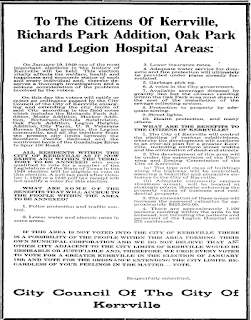 In January 1949 there was an effort to annex this and several other neighborhoods east of downtown. When put to a vote, the annexation failed.
One of the benefits of annexation was to be connection to city water. Even though the election had failed, in July of that year the county commissioners granted permission to the City of Kerrville to lay water mains in Oak Park and Legion Heights, so they got city water anyway.
After this there is very little additional news from Legion Heights.
To learn about other subdivisions in Kerrville go here.
The first two records of a sale was from O. W. Goss and wife to Thos. Dean Teague and wife (Bertha), lots 13, 14, and 15, and O. W. Goss and wife (Bessie) to H. C. Pope, lots 16, 17, 18, 19, 20, and 21.
Goss Street is the primary road.
 In January 1949 there was an effort to annex this and several other neighborhoods east of downtown. When put to a vote, the annexation failed.
One of the benefits of annexation was to be connection to city water. Even though the election had failed, in July of that year the county commissioners granted permission to the City of Kerrville to lay water mains in Oak Park and Legion Heights, so they got city water anyway.
After this there is very little additional news from Legion Heights.
To learn about other subdivisions in Kerrville go here.
Friday, March 4, 2016
B. C. Richards' First Addition
This subdivision lies across Quinlan Creek near Schreiner Institute.and opened in March 1924.
"Located on the high elevation adjoining the Presbyterian Encampment and the Schreiner institute grounds, these beautiful lots appeal to everyone who desires a home-site that combines all the natural advantages of good location with solid groves of Live Oaks on each lot, and besides cement sidewalks, cement curbs and graveled streets throughout the entire property."

The neighborhood is more or less from the corner of Travis and Aransas, north on Travis to Main, east on Main to Rawson, south to Aransas. It was once bordered on the south by the railroad.
To learn more about other Kerrville subdivisions, go here.
"Located on the high elevation adjoining the Presbyterian Encampment and the Schreiner institute grounds, these beautiful lots appeal to everyone who desires a home-site that combines all the natural advantages of good location with solid groves of Live Oaks on each lot, and besides cement sidewalks, cement curbs and graveled streets throughout the entire property."

The neighborhood is more or less from the corner of Travis and Aransas, north on Travis to Main, east on Main to Rawson, south to Aransas. It was once bordered on the south by the railroad.
To learn more about other Kerrville subdivisions, go here.
Wednesday, March 2, 2016
Methodist Encampment
Methodist Encampment is built around the Mount Wesley Conference Center. It is a community of homes originally built to provide housing for families attending the annual denominational encampment each year. The first season was 1924. Originally the homes were primarily for summer use, but today they are occupied year round.
The first mention of Methodist Encampment in the Kerrville newspapers was November 1, 1923, when the Kerrville Mountain Sun reported that H. C. Geddie "represented the local Chamber of Commerce in the matter of the Methodist Encampment for this city."
Then on February 7, 1924, the headlines in the Mountain Sun were "Kerrville Lands Methodist Encampment."
On April 1, 1924, a lot sale and barbecue were held at the Encampment grounds. An estimated 500-600 prominent Methodists ministers and laymen attended the opening. One hundred thirty lots ranging in price from $100 to $1000 were offered for sale on opening day. Ninety one of them sold. By then there were two roads from the Old Spanish Trail (Junction Highway) to the top of the mountain, a water system, electric lights, telephone, cafeteria, and a number of tents, all in preparation of the program beginning July 8 and lasting until August 3.
W.H. King was hired to construct the cafeteria for the camp--the first community building. The auditorium and commissary soon followed.
The first cottage builder (in 1924) was J. M. Calhoun. The house was a frame building finished with cobblestones. Other houses continued to go up, but the next mention of homes in Methodist Encampment was June 3, 1926, when Hill View Times reported on two new cottages. One was owned by Mrs. M. E. Moore of San Angelo. "It is a beautiful building with cobblestone front, and cobblestone columns. The grounds have been beautifully laid out, terraced, and flower gardens planted." The other was a "fine new 5-room house for Mrs. Phoebe Storms. [A] beauty in every respect, with front porch and sleeping porch". The builder for both was Moore & Saner, who was the contractor for most of the early encampment buildings. Many of these original cottages remain.
I have been told that Alice Street in Methodist Encampment was so named because the first owners were all from Alice, Texas, and similarly McAllen Street and Uvalde Street. Lazy Lane was originally Shady Lane. The name was changed sometime before September 1958 when rural mail service was extended to the Methodist Assembly area.
Kerrville has several historic neighborhoods suitable for listing on the National Register of Historic Places. This is one of them.
To learn about other Kerrville neighborhoods, go here.
The first mention of Methodist Encampment in the Kerrville newspapers was November 1, 1923, when the Kerrville Mountain Sun reported that H. C. Geddie "represented the local Chamber of Commerce in the matter of the Methodist Encampment for this city."
Then on February 7, 1924, the headlines in the Mountain Sun were "Kerrville Lands Methodist Encampment."
Kerrville's proposition of a site of 200 acres of ground with frontage on the Guadalupe River was accepted by the local committee of the Methodist Encampment, West Texas Assemby, subject to the raising of $11,500 by a local committee for purchase of the land.
The site accepted for the encampment consists of the Bud Porter place of 160 acres, including a hilltop from the J. J. Starkey place adjoining, not to exceed 40 acres in extent. The location is within three miles west of the city on the Old Spanish Trail.
On April 1, 1924, a lot sale and barbecue were held at the Encampment grounds. An estimated 500-600 prominent Methodists ministers and laymen attended the opening. One hundred thirty lots ranging in price from $100 to $1000 were offered for sale on opening day. Ninety one of them sold. By then there were two roads from the Old Spanish Trail (Junction Highway) to the top of the mountain, a water system, electric lights, telephone, cafeteria, and a number of tents, all in preparation of the program beginning July 8 and lasting until August 3.
W.H. King was hired to construct the cafeteria for the camp--the first community building. The auditorium and commissary soon followed.
The first cottage builder (in 1924) was J. M. Calhoun. The house was a frame building finished with cobblestones. Other houses continued to go up, but the next mention of homes in Methodist Encampment was June 3, 1926, when Hill View Times reported on two new cottages. One was owned by Mrs. M. E. Moore of San Angelo. "It is a beautiful building with cobblestone front, and cobblestone columns. The grounds have been beautifully laid out, terraced, and flower gardens planted." The other was a "fine new 5-room house for Mrs. Phoebe Storms. [A] beauty in every respect, with front porch and sleeping porch". The builder for both was Moore & Saner, who was the contractor for most of the early encampment buildings. Many of these original cottages remain.
I have been told that Alice Street in Methodist Encampment was so named because the first owners were all from Alice, Texas, and similarly McAllen Street and Uvalde Street. Lazy Lane was originally Shady Lane. The name was changed sometime before September 1958 when rural mail service was extended to the Methodist Assembly area.
Kerrville has several historic neighborhoods suitable for listing on the National Register of Historic Places. This is one of them.
To learn about other Kerrville neighborhoods, go here.
Friday, February 12, 2016
Richards Park

The Federal Housing Administration was created in 1934 during the Great Depression when the housing market was flat. The idea was to help construction workers get back to work and to help people become homeowners. At that time America was a nation of renters rather than home owners, fewer than half owning their own homes. Mortgage terms were very difficult, with large down payments, short repayment schedules of 3-5 years and final balloon payments. The FHA changed that.
To learn about other Kerrville subdivisions, go
here.
Wednesday, December 23, 2015
Oak Park
Oak Park is located between Schreiner University and the VA Hospital. According to descendants of W. L. Council, he and Dr. Wm. L. Secor saw a need for housing the families of men housed at the VA Hospital for the treatment of tuberculosis and in 1924 began developing this community for that purpose. Many of the houses were one bedroom and very affordable. He and Dr. Secor developed the first water treatment facility for the Kerrville area as well as the first sewage treatment facility. By 1938 the residents of Legion village and Oak Park were petitioning to be added to the city of Kerrville water system because the four-inch steel pipes were expensive to maintain and repair.
The first mention in the newspaper of Oak Park was on September 18, 1924, when it was recorded that W. L. Council and Wm. Lee Secor sold lots 13 and 14 of block 6, to E. F. Everett, and lots 15 and 16 of block 6 to Fred Kreis, who then immediately resold it to Mrs. Flossie M. Everett.
Both lots and houses were sold. Many of the houses advertised for sale were 4 room cottages.
 In 1925 Council and Secor began advertising "Why Pay Rent? Pay $10 down and $10 per month and buy a lot! Pay $50 down and $25 per month and build a home!" In addition, they were promoting its healthful elevation, excellent water supply, and beautiful shade trees.
The March 12, 1925, Kerrville Mountain Sun reported on the development of Oak Park. Described as a "real estate proposition of vast proportions", it initially was 58 acres which was augmented by the purchase from E. C. Meeker of between 160 and 200 acres between that development and the city of Kerrville. It was reported that nearly every original lot was sold and forty homes had been erected. It had its own water supply with mains running to every lot. An electric light plant was also planned.
Advertising also pointed out that Oak Park was NOT Legion. Oak Park was not on the highway and consisted of home owners, not renters. Note though that part of Legion Drive is in Oak Park Addition.
Community life developed quickly. In July 1925 it was announced that a Union Sunday School was being held in Oak Park in an arbor built for the purpose. There were five classes with forty members and occasional preaching. This appears to be the origin of Oak Park Baptist Church.
On January 11, 1949, an election was held to add over 1000 acres to the Kerrville city limits. Areas to be annexed included Richards Park Addition, Oak Park Addition, Legion Hospital, Meeker Addition, Mosty Addition, and the City Farm, as well as territory along the Guadalupe River to the south of the city which was described as being more or less between Schreiner Institute and Spur 100. It was rejected almost four to one. Oak Park was finally annexed to Kerrville in 1981, adding about 200 households and 135 acres to the city.
For a list of other Kerrville subdivisions, go here.
The first mention in the newspaper of Oak Park was on September 18, 1924, when it was recorded that W. L. Council and Wm. Lee Secor sold lots 13 and 14 of block 6, to E. F. Everett, and lots 15 and 16 of block 6 to Fred Kreis, who then immediately resold it to Mrs. Flossie M. Everett.
Both lots and houses were sold. Many of the houses advertised for sale were 4 room cottages.
 In 1925 Council and Secor began advertising "Why Pay Rent? Pay $10 down and $10 per month and buy a lot! Pay $50 down and $25 per month and build a home!" In addition, they were promoting its healthful elevation, excellent water supply, and beautiful shade trees.
The March 12, 1925, Kerrville Mountain Sun reported on the development of Oak Park. Described as a "real estate proposition of vast proportions", it initially was 58 acres which was augmented by the purchase from E. C. Meeker of between 160 and 200 acres between that development and the city of Kerrville. It was reported that nearly every original lot was sold and forty homes had been erected. It had its own water supply with mains running to every lot. An electric light plant was also planned.
Advertising also pointed out that Oak Park was NOT Legion. Oak Park was not on the highway and consisted of home owners, not renters. Note though that part of Legion Drive is in Oak Park Addition.
Community life developed quickly. In July 1925 it was announced that a Union Sunday School was being held in Oak Park in an arbor built for the purpose. There were five classes with forty members and occasional preaching. This appears to be the origin of Oak Park Baptist Church.
On January 11, 1949, an election was held to add over 1000 acres to the Kerrville city limits. Areas to be annexed included Richards Park Addition, Oak Park Addition, Legion Hospital, Meeker Addition, Mosty Addition, and the City Farm, as well as territory along the Guadalupe River to the south of the city which was described as being more or less between Schreiner Institute and Spur 100. It was rejected almost four to one. Oak Park was finally annexed to Kerrville in 1981, adding about 200 households and 135 acres to the city.
For a list of other Kerrville subdivisions, go here.
Sunday, December 20, 2015
Hal-Bart Addition
This subdivision is named for the developers Hal Peterson and Bart Moore.
Bart Moore first came to Kerrville on a road building contract in February, 1922. They built the highway from Ingram to Junction. When the job was finished he stayed, putting his mark on Kerrville. He built the Arcadia Theater.
Hal Peterson was a businessman who, among other things, established the Peterson's Garage and Auto Company that in time became the Kerrville Bus Company. He and his brother Charlie formed a charitable foundation that established the Sid Peterson Hospital. The foundation's mission expanded later to include other charitable pursuits in the area.
This subdivision is mentioned in one newspaper story from 1947 that said streets in the addition included Circle and Stephen. These today are part of Westland Place.
For a list of other Kerrville subdivisions, go here.
Bart Moore first came to Kerrville on a road building contract in February, 1922. They built the highway from Ingram to Junction. When the job was finished he stayed, putting his mark on Kerrville. He built the Arcadia Theater.
Hal Peterson was a businessman who, among other things, established the Peterson's Garage and Auto Company that in time became the Kerrville Bus Company. He and his brother Charlie formed a charitable foundation that established the Sid Peterson Hospital. The foundation's mission expanded later to include other charitable pursuits in the area.
This subdivision is mentioned in one newspaper story from 1947 that said streets in the addition included Circle and Stephen. These today are part of Westland Place.
For a list of other Kerrville subdivisions, go here.
Friday, December 18, 2015
Highlands Addition
here.This item has been modified based on reader feedback.
On the same day--within minutes of each other--two people asked about the Highlands Addition to Kerrville so I'll write about this subdivision next.
The first mention of Highlands Addition in the newspaper was on November 24, 1949, when Walter Erma Wenzel sold lot number 7 in block 1, Highlands Addition, to Jesse Leroy Hancock and wife. On February 21, 1951, a story appeared in the Kerrville Mountain Sun about the growth of the new development, which had been underway for more than two years. Walter Wenzel, a former clothier in Houston, was the project developer.
Walter and Erma Wenzel and children Dolores, Charlotte, and Walton, had moved to Kerrville from Houston in January, 1947, after expansion of the Foley department store forced him to close his clothing store. The February 12, 1948, Mountain Sun reported that Clarence B. Williams sold to Walter Wenzel 95 acres of land in surveys 122 and 123. This was the beginning of Highlands Addition.* By 1952 there were 14 families living in the development.
The homes "of necessity and for the protection of the builders, must be restricted to certain types". A natural gas line had been run, city water lines had been laid, and telephone lines. Residents had septic systems until after 1965, when they were connected to city sewer lines. Most of the streets were paved, but by 1958 they were worn out, at least on Glen Road and East Lane. To get the streets repaved, the property owners had to agree to an assessment by the city for concrete curb and gutter, and asphalt pavement.
The first house built on the section of Glen Road between Methodist Encampment and East Lane was 1530 Glen Road, which was purchased by Henry Eugene and Esther Stover on February 14, 1950.
Walter Wenzel lived in the neighborhood he developed until his death in 1977, although not in their original house.
At the time it was being developed--one mile outside the city limits, one selling point was that there were no city taxes. That's often a selling point for real estate today!
Ironically, four years after the first lots were sold, the subdivision was annexed to Kerrville May 22, 1952.
*A story appeared in the March 17, 1949, Mountain Sun reporting on a new 95-acre subdivision being platted adjacent to the city northwest of the Methodist Assembly. The owner was Rev. A. B. Wagner, pastor of Holy Cross Lutheran Church. Walter Wenzel was reported to be assisting the owner with the development of the land. This was the same church the Wenzels attended. I think this is the same property that became Highlands, but until I can get to the courthouse and look at the deed records I can't be absolutely certain.
To learn about other Kerrville subdivisions, go here.
On the same day--within minutes of each other--two people asked about the Highlands Addition to Kerrville so I'll write about this subdivision next.
The first mention of Highlands Addition in the newspaper was on November 24, 1949, when Walter Erma Wenzel sold lot number 7 in block 1, Highlands Addition, to Jesse Leroy Hancock and wife. On February 21, 1951, a story appeared in the Kerrville Mountain Sun about the growth of the new development, which had been underway for more than two years. Walter Wenzel, a former clothier in Houston, was the project developer.
Walter and Erma Wenzel and children Dolores, Charlotte, and Walton, had moved to Kerrville from Houston in January, 1947, after expansion of the Foley department store forced him to close his clothing store. The February 12, 1948, Mountain Sun reported that Clarence B. Williams sold to Walter Wenzel 95 acres of land in surveys 122 and 123. This was the beginning of Highlands Addition.* By 1952 there were 14 families living in the development.
The homes "of necessity and for the protection of the builders, must be restricted to certain types". A natural gas line had been run, city water lines had been laid, and telephone lines. Residents had septic systems until after 1965, when they were connected to city sewer lines. Most of the streets were paved, but by 1958 they were worn out, at least on Glen Road and East Lane. To get the streets repaved, the property owners had to agree to an assessment by the city for concrete curb and gutter, and asphalt pavement.
The first house built on the section of Glen Road between Methodist Encampment and East Lane was 1530 Glen Road, which was purchased by Henry Eugene and Esther Stover on February 14, 1950.
Walter Wenzel lived in the neighborhood he developed until his death in 1977, although not in their original house.
At the time it was being developed--one mile outside the city limits, one selling point was that there were no city taxes. That's often a selling point for real estate today!
Ironically, four years after the first lots were sold, the subdivision was annexed to Kerrville May 22, 1952.
*A story appeared in the March 17, 1949, Mountain Sun reporting on a new 95-acre subdivision being platted adjacent to the city northwest of the Methodist Assembly. The owner was Rev. A. B. Wagner, pastor of Holy Cross Lutheran Church. Walter Wenzel was reported to be assisting the owner with the development of the land. This was the same church the Wenzels attended. I think this is the same property that became Highlands, but until I can get to the courthouse and look at the deed records I can't be absolutely certain.
To learn about other Kerrville subdivisions, go here.
Wednesday, December 16, 2015
Motley Hills
The developer of Motley Hills was Delmar H. Motley. This subdivision was developed on land purchased from Schreiner Institute (now Schreiner University) in 1961. The first record of the sale of a lot in Motley Hills is Citriana Development Co. to William C. Kenthick? Jr., and wife who purchased lot 3 in block M of Motley Hills Subdivision. This was reported on the February 7, 1962, Kerrville Mountain Sun. However it was a week later that the Mountain Sun reported the City Council had reviewed the plats.
In October 1963 a rather nice spec house in Motley Hills was advertised for sale for $13,900. It featured three bedrooms, two tile baths, electric kitchen, central heat and air conditioned, double garage, laundry room, and insulated! Was insulation an unusual feature in a house?
The February 9, 1961, Kerrville Mountain Sun had the following item:
Meeker Land Sold For SubdivisionThen on February 23, 1961, the following item appeared in the Mountain Sun:
Delmar Motley of McAllen has purchased nine acres from Burton Meeker near the National Guard Armory and plans to start a subdivision of low cost housing. Motley said the homes will have brick veneer, have two and three bedrooms, and will sell for less than $10,000.
68 Acres Tract Sold To Motley By S. I. Board.
Sale of 68 acres of land to D. H. Motley was announced this week by Dr. Andrew Edington, president of Schreiner Institute. The land, which lies along Travis Street, adjoining the city limits, was sold for approximately $500 an acre.
Motley, who is from McAllen, plans to start a subdivision on the tract this week end, priced from $8,000 and up. Motley had previously talked about buying some land from Burton Meeker for the subdivision.
To learn about other Kerrville subdivisions, go here.
Sunday, November 29, 2015
Starkey Manor
Starkey Manor Subdivision was first advertised in the October 10, 1946. "Exclusive Home Sites--Highly Restricted." Tracts varied from 1 1/4 to 3 1/2 acres each and were priced from $1100 to $1500 an acre. Interestingly, each lot could have two homes on it. City water and paved streets were guaranteed, as well as electricity and telephone service. Some of the advertised restrictions included building restrictions "set at appropriate financial levels" and private residential construction.
It appears the very first lot sold was to Paul J. Broyles and his wife in September of that year.
In the fall of 1947 3 bedroom, 2 bath ranch-style houses were being constructed along Methodist Encampment Road as spec houses selling for about $13,000.
Starkey Elementary, built in "outer Westland", was built to serve the growing population in the western suburbs. It welcomed its first students in September 1949. In the May 26, 1949 Kerrville Mountain Sun, it was described as a seven room school with one teacher in each class to serve grades one through six. One teacher would act as principal, one would also teach music. It was thought first grade would probably go morning only, the other students having all day schedules.
The Mountain Sun of August 11, 1949, reported the first teachers were: Dan Price, head teacher and mathematics; Mrs. Henry C. Hahn, first grade; Miss Yetive Watkins, second grade; Mrs. Roy Littlefield, Jr., third grade; Miss Betty Jo Brown, fourth grade; Mrs. A. F. Forvilly, fifth grade, and Miss Dorothy Staudt, music. No 6th grade teacher was named--but there must have been one because the 6th grade is mention in other news stories. Due to segregation, Starkey served only the white elementary students living west of Town Creek--166 total the first year. Those east of Town Creek, 646 in all, went to Tivy Elementary.
Those seven classrooms were insufficient. One year later a contract was let for a seven room addition to Starkey, doubling its capacity.
To learn about other Kerrville subdivisions, go here.
It appears the very first lot sold was to Paul J. Broyles and his wife in September of that year.
In the fall of 1947 3 bedroom, 2 bath ranch-style houses were being constructed along Methodist Encampment Road as spec houses selling for about $13,000.
Starkey Elementary, built in "outer Westland", was built to serve the growing population in the western suburbs. It welcomed its first students in September 1949. In the May 26, 1949 Kerrville Mountain Sun, it was described as a seven room school with one teacher in each class to serve grades one through six. One teacher would act as principal, one would also teach music. It was thought first grade would probably go morning only, the other students having all day schedules.
The Mountain Sun of August 11, 1949, reported the first teachers were: Dan Price, head teacher and mathematics; Mrs. Henry C. Hahn, first grade; Miss Yetive Watkins, second grade; Mrs. Roy Littlefield, Jr., third grade; Miss Betty Jo Brown, fourth grade; Mrs. A. F. Forvilly, fifth grade, and Miss Dorothy Staudt, music. No 6th grade teacher was named--but there must have been one because the 6th grade is mention in other news stories. Due to segregation, Starkey served only the white elementary students living west of Town Creek--166 total the first year. Those east of Town Creek, 646 in all, went to Tivy Elementary.
Those seven classrooms were insufficient. One year later a contract was let for a seven room addition to Starkey, doubling its capacity.
To learn about other Kerrville subdivisions, go here.
Friday, November 27, 2015
Kerrville Subdivisions
Some time back I began compiling a list of Kerrville Subdivisions with their dates of creation and wrote about some. I've compiled a list of subdivisions in Kerrville created no less than 50 years ago. This is probably not a complete list. I welcome additions. Some subdivisions were developed over several years. I am looking for the dates of zoning approval or date of first houses in development.
Hillcrest September 1922
Buena Vista 1923 (includes 700 block of Wheless, Myrta, Moore)
B. C. Richards First Addition 1924
Methodist Encampment 1924
Oak Park by September 1924
Henry Wallace Addition 1925, No. 2 October 1945
Westland Place auctioned May 7, 1925 (738 lots)
Westland Hills sales kicked off Jan 1, 1926
Valley View Addition 1926
Oak Hill Addition 1928 (includes site of former Mayor Remschel home)
Richards Park Addition November 1941
Legion Heights October 1945
Hill Top Estate September 1946 (George H. and Mrs. Mary Miers granted permission to plat 22.65 acres)
Starkey Manor October 1946 (Mrs. Pattie Starkey and A. L. Starkey Jr. to plat 123.63 acres.)
Blue Bell Hills October 1947
Hal-Bart October 1947
Highlands Addition 1949
Guadalupe Heights August 1950
Richardson Addition 1951 (includes a seven block area adjoining Westland and the Hal-Bart addition) No. 3 1962
Murray Heights September 1961
Motley Hills 1962 (section 2 1966)
Price Addition April 1962
Fawn Valley Estates April 1962 (on Harper Road)
College Cove 1963
Mills-Miller Subdivision ??
Hazy Hills 1964
Royal Oaks 1965
Colonial Manor 1967
Shady Grove 1967
Riverhill 1967 (originally known as Tamanaco Estates, then Forrest Hills)
Subscribe to:
Posts (Atom)