Saturday, March 8, 2014

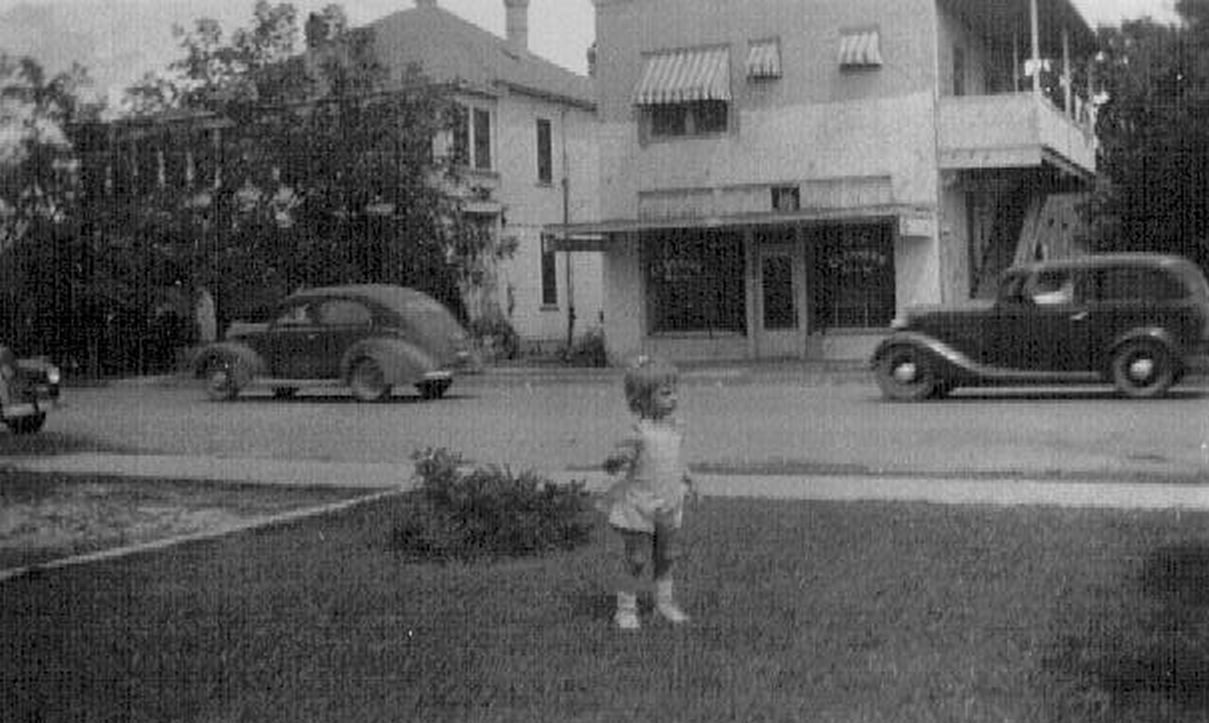
602 Bluebell Road

This ranch-style house in Blue Bell Hills, erected in the early 1950's, has provided meeting space and parking for Trinity Baptist Church since 1990.
I wrote about the Blue Bell Hills development here.
There have been many property owners, few of whom lived here long--averaging about three years each until the church bought it. This won't be a particularly interesting blog post. Most of them weren't in the news much, probably because most didn't live here long. Perhaps one of you can add some color.

In November 1949, Blue Bell Hills sold to Jim W. Weatherby, trustee, part of lot 12 block 1 of the Blue Bell Hills Addition.  In August 1950, Weatherby in turn sold the property to Don and Marjorie Bowen who, two months later, sold the lot to Carroll and Ethel King.
The Kings may be the ones who built the house.  He worked for the Kerrville Bus Company before moving to Midland in September 1951. 
In the 1950 city directory the address does not exist.  In the 1952 directory the house was up, but vacant. As a matter of fact, the house was listed as vacant in all the city directories from 1952 to 1956, sometimes with the address of 600 Bluebell.

In 1952 T. O. "Dick" and Hattie Mae Midkiff sold to A. A. and Georgia Wehmeyer.  After Georgia died in 1954, her widower continued to live here until December 1956 when he sold the house to Paul Meredith.
In March 1957, the newspaper reported as front page news that Mrs. Courtlandt Eaton, age 73, of 602 Blue Bell Road, had died.  A native of Montreal Canada, Mrs. Eaton (nee R. H. Martel Davis) had lived in Golden, Colo., coming to Kerrville in September of the previous year.

James R. England purchased the property in 1958.  The April 2, 1958, Kerrville Times reported his arrival along with the news that his first duty was to go to Austin for a briefing.  Sgt. England was the new head of the Kerrville sub-district office of the State Highway Patrol.

The city directory reported that the house was vacant between 1962 and 1965.
Over the next twenty five years there were seven owners.
For those really interested other owners and residents include: 1967-1972 realtor Temple J. Duderstadt, 1975 Shirley Swindel, 1975-76 Dean Guy (who remodeled), 1977 H. Ellis Thomas who sold to Norman E. Mayfield in September of that year, September 1977-February 1980 Mr. and Mrs. Norman E. Mayfield, 1980-86 Mrs. Lillian D. Edwards; 1986 Marguerite and Floyd Forehand.  Forehand was a football, track and basketball coach at Peterson Middle School for a short time before going to Schreiner College (now Schreiner University) in a coaching position.

In September 1990, Trinity Baptist Church bought the properties at 602 and 606 Bluebell Road for parking. While 606 is gone, this house is not.  Instead, much of its lot was paved and the house used for church activities. Newspaper mentions call it the Trinity Baptist Annex.

Wednesday, March 5, 2014

223 Clay Street


2014

According to the Sanborn fire insurance maps, this building at 223 Clay Street
1931
was constructed sometime between 1924 and 1930, and more likely close to the later date since the first mention in the newspaper was in 1931. (It was not on the map in 1924, but was in 1930.)

These two photos do indeed show the same building. The second story was removed in the 1950s when it became rickety and unsafe.

The first mention of this building was in the September 3, 1931, Kerrville Mountain Sun, when the following ad appeared: "Rusche Grocery, 223 Clay Street.  'The Store with Dependable Foods'--We Deliver."  In late March, 1931, Alfred Rusche had bought the Heiman grocery at the corner of Jefferson and Clay.  Within the next five months he moved the business one block down the street to this building.  He was in business in this location less than two years. By March 2, 1933, Rusche had moved to the Brown Building at the corner of Earl Garrett and Main and opened a Maytag dealership in conjunction.

The September 7, 1933, Kerrville Mountain Sun reported the following
Bud Neely Opens Grocery Store at 223 Clay Street.
Bud Neely, who has been connected with the grocery business for a number of months in Kerrville will open a new grocery store Friday at 223 Clay Street.  The store will be known as the C. O. D. grocery, and will be a serve-yourself store with the additional features of a delivery service on orders telephoned where the amount purchased is one dollar or over.
The building in which the store is to be operated was formerly used as a grocery and was known as Ruche's store.  Mr. Neely has had the building entirely renovated and redecorated. The stock is being placed on the shelves at this time. ...
The six weeks later the following item appeared in the Kerrville Times:
"Bud" Neely in Water Street Location.
...Mr. Neely expects to move the stock of groceries from his present establishment, the C.O.D. Grocery at 223 Clay Street, to the Kerrville Food Store.  The new institution willbe known as the C.O.D. Grocery,  He will close up the 223 Clay street place, and concentrate all of his business at the new location.

The next mention is a report in January 1934 that the "[o]ffices of the Kerr County Board of Welfare and Employment were moved early this week from the Brown building on Earl Garrett Street to 223 Clay Street."
It was followed by D-C Cleaners, a firm owned by Nelson Davis and J. C. Cavness, which offered cleaning, dyeing, and general tailoring. Although ownership changed in 1945, D-C Cleaners continued from October 1937 to June 1948.
When it was D-C Cleaners


 In June 1948 John Potts Weatherford, from Amarillo, purchased the business from Bernard Sherlock and changed the name to Potts Dye Works.
Although one story today, during the early years there was a second story apartment. It was frame construction and probably intended as living quarters for the business owner.  The 1936 city directory shows tenants living upstairs.  I found one newspaper announcement indicating use as a rental apartment.  The June 11, 1942, Kerrville Mountain Sun reported
Daughter's Marriage Announced
Mrs. Mary Brusher has announced the marriage of her daughter Mary Patricia, to Frank James, Jr., son of Mr. and Mrs. Frank James.  The ceremony was performed in Boerne on April 7.  Mr. and Mrs. James are residing at 223 Clay Street.
They would have occupied the now-removed second story.

E. B. Meeker & Sons feed store was here in 1951, then in March 1952, Charles Adamek purchased the land and building from the executors of the estate of Richard Holdsworth, deceased.  Adamek immediately obtained a permit for building alterations. When completed he moved his business, the Kerrville Saddle Shop, in.
The Adameks ran the Saddle Shop here from April 1952 until retirement in 1978.
A  western store followed, until early 1988. It has since been home to a taekwondo studio, then a music studio.

Article updated April 4, 2018, to include D-C Cleaners photo.

Saturday, March 1, 2014

840 Earl Garrett Street

An earlier survey of historic homes in Kerr County called this the Sid Peterson home. One might just as well call it the A. M. Kennedy house.
Its porch architecture, the most notable feature, is described this way: "Classical Revival use of simple double and single Doric columns to create a large southeast porch, a popular form of the early 20th century."
2012

ca 1988. Kerr County Historical Commission Collection.
This house was built for Austin Milton Kennedy in 1914 and was owned by several business and political leaders over the years.  A. M. Kennedy died from tuberculosis on July 19, 1914, before the house was finished.
Austin Milton Kennedy was a Texas state representative and speaker of the Texas House during the 31st legislature (1909-1910).  Sam Rayburn, who later became Speaker of the U.S. House of Representatives, was one of his honorary pallbearers.
He purchased a lot 100'x200' from B. F. Hicks on March 23, 1914, for $150 ($50 cash and $150 note) and began work on the house. It appears the house was unfinished when Kennedy died.  On August 7,  three weeks after his death, A.M. Kennedy's widow, Marion, transferred the property "having a residence thereon built by A. M. Kennedy" to James M. Kennedy for $2500 and assumption of the note to B. F. Hicks.  James Kennedy may be a relative, perhaps a brother, but I haven't been able to find A.M. Kennedy in the census before 1900 to determine that.

On October 9, 1919, J. M. and wife Sallie Kennedy sold the property to H. C. Geddie and Lee Wallace for $1800. (Geddie was the mayor of Kerrville and Wallace the Kerr County Judge at the time.) Four days later, Geddie and Wallace sold to Sid and Myrta Peterson for $2,250.  Sid Peterson is the man for whom the local hospital is named.  He and his three sons had heart conditions and knew first hand the difficulty of traveling the 60 miles to San Antonio for anything more than basic medical care.  After he died in 1939, in San Antonio, his sons vowed to build a modern hospital to Kerrville. The hospital admitted its first patients in July 1949.

Sid Peterson had many business interests. He was the founder of Peterson Auto Company and Garage, the Kerrville Bus Company, the American Pure Milk Company, and the Peterson Farm.  He also owned a ranch in Edwards County.

They lived in this house about ten years.  In February and March 1929, Sid Peterson and Newton B. Smith swapped several pieces of property, including an undertaking business and this house, which on March 5, 1929, the Petersons sold to Newton B. Smith for $11,000 "Together with all improvements thereon and all household furniture and fixtures now contained in the dwelling house situated on said land." Smith had been a "popular" undertaker in Kerrville. After the sale he became an agent for the Magnolia Petroleum Company. In 1931 Newton Smith sold to his niece Nelly Smith, who lived with him, a 60'x80' piece of this land.  In 1942 the house was inherited by his daughter Leona Rawson. In December 1943 she sold the property to chiropractor Francis G. Bailey, who moved his office here from 1613 Broadway.

In 1947 a part on the corner of Myrta and Earl Garrett Streets was sold to Sam. H. Taylor and W. B. Priest to build apartments.  In 1959 it was bequeathed to the Methodist Home Foundation. In June 1971 they sold it to Kenneth and Glenda Greeson who owned it until selling it in 2005 to Lifestyle Homes, LLC.  Today it houses small offices.

Wednesday, February 26, 2014

328 Hays Street--Helping build a photographic history

The focus of this blog has been exploring the built environment of the Hill Country, with an occasional side trip.  I have several building histories in the works with I need to finish, but today I'm doing something different to introduce you to a new website I've just discovered http://www.whatwasthere.com

This is the Collins Company building.  Its address in 1932 was 328 Hayes Street, but that address today is part of the HEB employee parking lot on Hays between Main and Jefferson Streets.  This photo was taken in 1932, but when I looked at the 1930 Sanborn fire insurance map, there was no building in that block that matched this.  I turned to http://www.newspaperarchive.com and found a number of news items about the Collins Company, a wholesale grocery business.  Here's one from the July 10, 1931, Kerrville Mountain Sun.
Collins Company Again Victimized by Burglars; Loot Valued at $1,000.
For the third time in recent months, the Collins Company, wholesale grocery firm, Tuesday night became a victim of cigarette thieves who made away with a large haul.
The loot consisted of 14 cases of cigarettes, valued at approximately $1,000.  Entry to the warehouse, corner of Schreiner and Hays Streets, [emphasis mine] was gained by breaking the lock on a rear door.  ...
It is believed that an organized band of cigarette thieves is at work in this section, since similar robberies are occurring frequently in small cities and towns surrounding San Antonio.

Some building numbers have changed over time, this being one of them.  The Sanborn map showed that this business once was located in the same block where the city recycling center is, in the corner nearest the traffic light. 

You can find this photo and others at a new website http://www.whatwasthere.com .  It ties historical photos to modern locations using Google maps, building a photographic history of the world. I have put a number of Kerr County photos up--as well as couple from other places.  You can link to it from Facebook as well.  Come join me!


Sunday, February 16, 2014

235 Earl Garrett Street

This small building at 235 Earl Garrett Street was built sometime between 1904 and 1910. It has a distinctive skylight, a feature I've not seen in any other local building of that period.
The Sanborn Fire Insurance maps show that in 1904 there was a frame building at this approximate location. By 1910 it had been replaced by this stone building and housed a jewelry store. In 1916 it was a jewelry and millinery shop.
There is a gap in the record between 1916 and 1925.

In January 1925 Isaac W. Van Hoozer purchased the dry good and grocery stock of bankrupt J. W. Burney's store on Schreiner Street and moved it to the building Van Hoozer owned on Earl Garrett, "next to the Kerrville Tailoring Company" according to the February 19, 1925, Kerrville Mountain Sun. Van Hoozer had remodeled and refinished the building and opened the store for business the previous Monday morning (February 16).
Also in January, 1925, I. Van Hoozer, along with other property owners on Earl Garrett Street, was assessed for street repairs. (I was reminded of the game Monopoly!) His assessment was based on owning 13 feet of frontage on Earl Garrett.  The other property owners on the block were M. F. Weston who owned 129 feet; A. C. Schreiner, 50.5 feet; E. E. Dietert 31.0 feet; E. Hawes, 78.9 feet; Sid Peterson 75.5 feet; and C. Wheelus 43.1 feet. (Wheelus owned the Guthrie Building.)

Van Hoozer's business didn't last long, because the July 7, 1927, Mountain Sun reported the following: "Richard Smith, John Burkhardt, and Charles Durrin have opened a restaurant and lunch on Earl Garrett Street in the building formerly occupied by the grocery of I. W. Van Hoozier [sic] & Son.  The interior of the lunch room, which is under the management of Mr. and Mrs. Charles Durrin, is nicely arranged." There is no indication of the name of this business.  Durrin had previously owned a lunch room called the "Midget Lunch Room", also on Earl Garrett Street, and later owned one in the 800 block of Main Street.

The next mention in the newspapers of a business at this location is the Post Office Barber Shop, which is mention for the first time in the newspaper in 1936--the year the new Post Office opened in Earl Garrett Street. This is very likely the same time the barber shop opened. It was owned for many years by W. L. Tillson. When he retired in 1973 he sold to John F. Tom.

When, after many years the Post Office Barber Shop closed, it was followed by the Smokehouse, which sold tobacco products and paperback books. The Smokehouse moved from an earlier location on Water Street. This building is still often referred to as "The Smokehouse" even though it most recently was a law office.

An interesting item I found is the fact that after Isaac Van Hoozer died his son Floyd sold off part of the building, keeping one side, renting out part.  The other part may be in the area where the small garden is today, but I am not sure.  I need to spend more time in the deed books. 


Tuesday, January 28, 2014

"Texas Treasure" Business Award

The Kerr County Historical Commission is compiling a list of businesses in Kerr County that qualify for the "Historic Business--Texas Treasure" award.
This award recognizes Texas businesses "that have provided employment opportunities and support to the state's economy for at least 50 years."
http://www.thc.state.tx.us/preserve/projects-and-programs/texas-treasure-business-award

The full requirements can be found at the above link, but in general, businesses must have been in continuous for-profit operation in Texas for at least 50 years and must continue to operate the same or very similar business.  The business may have changed hands.  Businesses that have stayed in the same family or have operated from the same place for more than 50 years get special recognition. 

The business gets an attractive certificate to hang on the wall--which it agrees to display. 

Mosty Brothers Nursery, Center Point, est. 1897, is the first business in Kerr County to receive this award.

Here is a list of other for-profit businesses based in Kerr County that appear to qualify.  There may be more. City is Kerrville unless otherwise indicated.


  • Have been in continuous for-profit operation in Texas for at least 50 years. 
  • Continue to operate the same or a very similar type of business as it did at least 50 years ago.
  • Have a continuous record of employment for at least the past 50 years.
  • Continue to operate as an independent, for-profit business (i.e., it cannot be operating as a subsidiary of or have been absorbed into another business)
  • Maintain a good business relationship with the state.
  • - See more at: http://www.thc.state.tx.us/preserve/projects-and-programs/texas-treasure-business-award#sthash.wyOqJbeu.dpuf
    • FIRST Insurance Agency of the Hill Country, 1890.
    • T. J. Moore Lumber Yard, Ingram, 1892. 
    • Kerrville Daily Times, 1910.
    • Sanchez Barber Shop, 1911.
    • Garrett Insurance,  1918.
    • Grimes Funeral Chapel, 1920.
    • Camp Rio Vista, Hunt, 1921.
    • Camp Stewart, Hunt, 1924.
    • Kerr County Abstract Company, 1924.
    • Camp Waldemar, Hunt, 1926.
    • Camp Mystic, Hunt, 1926.
    • Camp La Junta, Hunt, 1928.
    • Camp Waltonia, Hunt, 1928.
    • Crider's, Hunt, 1926.
    • Mosty's Garage 1926. 
    • Kerrville Bus Company, 1929. 
    • R.C. McBryde Oil, by 1931. 
    • Fidelity Abstract and Title,  1936.
    • Heart of the Hills Taxidermy,  1937. 
    • Kickapoo Kamp, 1943.
    • Del Norte Restaurant, 1946.
    • The Hunt Store, Hunt, 1946. 
    • Mooney Aircraft, 1946.
    • Heart O' the Hills Camp, Hunt, 1949. 
    • Hill Country Telephone Cooperative, Ingram. 1951.
    • Hester Window Coverings, 1951.
    • Bernhard's Meat Processing and Market, Ingram,  1952.
    • Hill Country Affordable Motors,  1954.
    • Hunt-Ingram Gas Company, Ingram, 1955.
    • The Rose Shop, 1955.
    • Inn of the Hills, 1963.
    • Herring Printing, 1964.

    If you have others to add to this list, you can comment below or contact me at my blog email address, dgaudier at gmail.com, and I will update this list.

    Saturday, January 25, 2014

    Center Point Depot

    1939.  Kerr County Historical Commission Collection.
    Date unknown.
    2013

    The peripatetic 1877 San Antonio and Aransas Pass Railroad Depot of Center Point, has returned to Center Point from Boerne and is being restored.  It is now in a historic park on San Antonio Street.
    The depot has not just seen a lot of travelers, it has also done a lot of traveling.  It isn't unusual for old buildings in Kerr County to be moved to new spots.  It is unusual for one to move multiple times.
    The depot was closed after the last train ran in 1971. A story in the September 1, 2012, Kerrville Daily Times, about the return of the depot to Center Point said that in 1984 it was moved to Kerrville where it then served as a private home for almost a decade. 
    C.D. Peterson was the one received a permit to move the depot to Kerrville in October 1984. While in Kerrville it was located near the corner of Texas 16 North and Loop 534. A few years later it was sold again and moved to Boerne where it housed offices for a few years. The Center Point Historical Preservation Association raised the money to move the depot back to Center Point in 2012, and is now raising money to complete restoration of the building.

    The January 24, 1995, Daily Times reported on an effort by the Comfort Area Development Board to move the depot to that community. The project was apparently unsuccessful. That story called this the second depot building in Center Point.

    The December 5, 1984, Kerrville Mountain Sun recounted the memories of Fred Toler, who was a railway agent at Center Point in 1934-35, then again from 1937 for a while. He tells this story:
    One day Mr. Holchak [the Southern Pacific agent in Kerrville] told me that the agent's job at Center Point was coming open and he thought I could handle the job. ... Myrtle Elizabeth Baker and I ... decided this was our chance to get married.
    ... Myrtle and I went down to Center Point and looked things over and as we would be flat broke until we received our first pay check we decided to move into a large room connected to the depot.
    Myrtle's mother gave us a table and two chairs, my mother contributed a bed and mattress, the kinfolks gave us a shower of household goods.  
    We had no honeymoon as we had to go to work the day after [we were married].
    The Center Point job paid $50 per month, which looked like a small fortune to us.
    The first night we stayed in the depot we had just laid down when we heard a commotion and looking out the window we saw about fifty people coming towards the depot.
    We were both somewhat uneasy, but I put my clothes on and went out to see what was up.  A man named Frank Lane headed the group and he told me that it was customary whenever anyone got married in the town to "chiveree" them.
    Mr. Lane explained that it was the town custom to "serenade" newly couples and that we were supposed to furnish refreshments.  They had brought along a fiddle and guitar player and we would have a dance.
    The only refreshments we had was coffee, but they didn't seem to mind.  So the music was set upon the large outside unloading platform and the dance when on until about midnight when everyone went home.
    ... About the time we received our first check the Superintendent of the S.P. dropped off a train one day and told us we would have to move out of the Depot and rent a house.  
    We rented one-half of a duplex for $12 a month.  It was one of the few houses in town that had inside plumbing." 
    A true luxury!

    After about a year he was transferred to Fredericksburg Junction, about five miles below Comfort, the first of several transfers in his railroad career. (Fredericksburg Junction should not be confused with Frederickburg. It sat in the middle of nowhere and was the spot where the Fredericksburg and Northern Railway connected with the S.A.&A.P.)