Thursday, April 24, 2014

Trouble at the Depot--1915

You never know when you'll stumble across an interesting little-known tale.  Yesterday, I did some research for the owner of Depot Square, and discovered a little known controversy surrounding the former San Antonio and Aransas Pass Railroad depot in Kerrville, now housing a restaurant--Rails-A Cafe at the Depot. The depot was erected in 1915 to replace an earlier frame one destroyed by fire. I have just discovered that the construction of this depot was so controversial that the debate appeared in papers across the state. 
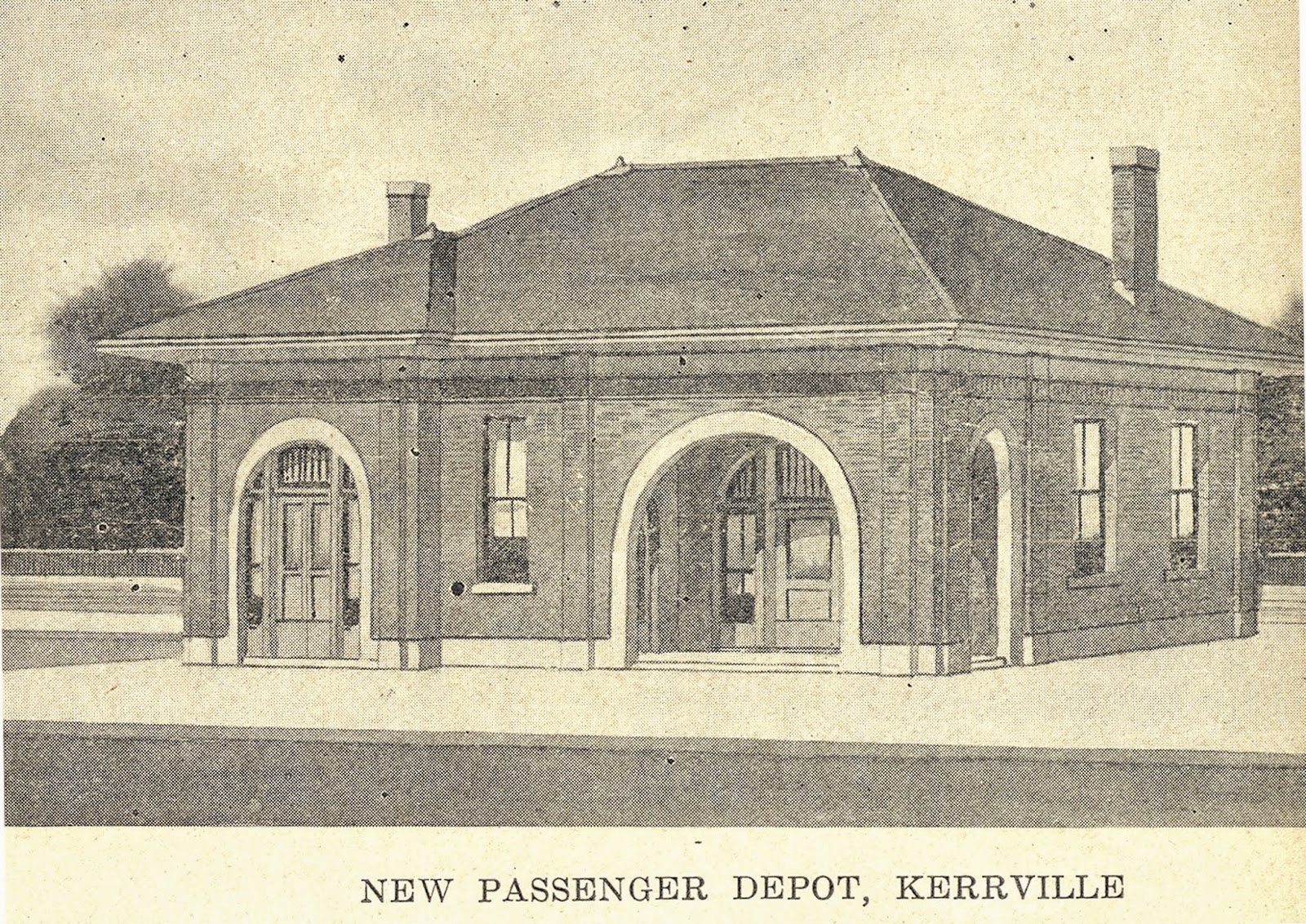
A March 20, 1915, story in the Kerrville Mountain Sun reported that this new brick depot was to be ready in 60 days--in time for the summer tourist trade.  Newspaper accounts at the time suggest the depot was finished more or less on time, so that wasn't the controversy.  The story unfolds below.  It began with a lawsuit filed by certain currently unknown parties in Kerrville to prevent the use of the depot.


The first mention of the controversy appeared in the July 31, 1915, Mountain Sun. The newspaper reported the following:
The injunction suit against the San Antonio & Aransas Pass Railroad company seeking to prevent that compnay from using their new depot erected between Clay and Tchoupitoulas streets was heard in vacation by Judge Barney Wednesday.  General Attorney A. J. Boyle, General Manager J. S. Peter, Land and Tax Agent Geo. Chamberlain, of the Aransas Pass were among those in attendance.  Barnett & Geddie were attorneys for the plaintiffs.  The trial of the case consumed a greater part of Wednesday, Thursday and Friday, and resulted in the injunction being granted as prayed for. 
Have any of my readers heard this story?  Does anyone have any idea who the plaintiffs were--other businessmen, local residents, elected officials? 

The following appeared in the Galveston Daily News, May 10, 1916, p. 7, as part of the report of the regular monthly session of the railroad commission, which at that time actually concerned itself with matters pertaining to the railroad! 
Argument was heard in the Kerrville depot controversy, where there is a division between the mayor and some of the citizens.  Today's petition asked the commission to order the San Antonio & Aransas Pass Railroad to build and maintain what was characterized as an adequate passenger station at Kerrville, located on the old depot site and on the south side of the tracks.  It also protested against the petition of the mayor of Kerrville and the San Antonio &  Aransas Pass Railroad for permission to use the brick depot constructed by the San Antonio & Aransas Pass.  The new depot is declared inadequate and unsuitable and inconveniently and dangerously located.  There is a injunction pending in the courts to prevent the use of the depot.

Why was this new building considered "inadequate and unsuitable and inconveniently and dangerously located"?

The San Antonio Evening News of September 18, 1919, p. 5 reported that the Kerrville SAP Depot hearing had been postponed.
More items about the controversy appear in the Evening News for several weeks. Then the October 27, 1919, Evening News reported a resolution.
Order Will Compel Use of New Depot
Austin, Tex., Oct. 25?--Assistant Attorney General W. J. Townsend is drawing an order for the Railroad Commission which will require the San Antonio & Aransas Pass Railroad Company to use its new brick depot at Kerrville.  This follows the hearing and the two years' legal controversy.  Some two years ago the commission ordered the Sap to build a new depot at Kerrville.  The railroad erected a handsome brick structure, but on an entirely new site.  Its use was enjoined by certain citizens, and it has been closed for 18 months.  When issued the order now being prepared will permit the railroad to move into its new quarters.
Few 1919 issues of the Kerrville newspapers exist, so we cannot determine exactly when the passenger depot finally opened, but presumably before the end of the year 1919.

So, loyal readers, do any of you know more about the lawsuit or the parties involved or have anything to add to this story?  You can comment below, or email me at dgaudier at gmail dot com

Sunday, April 20, 2014

Easter a Century Ago

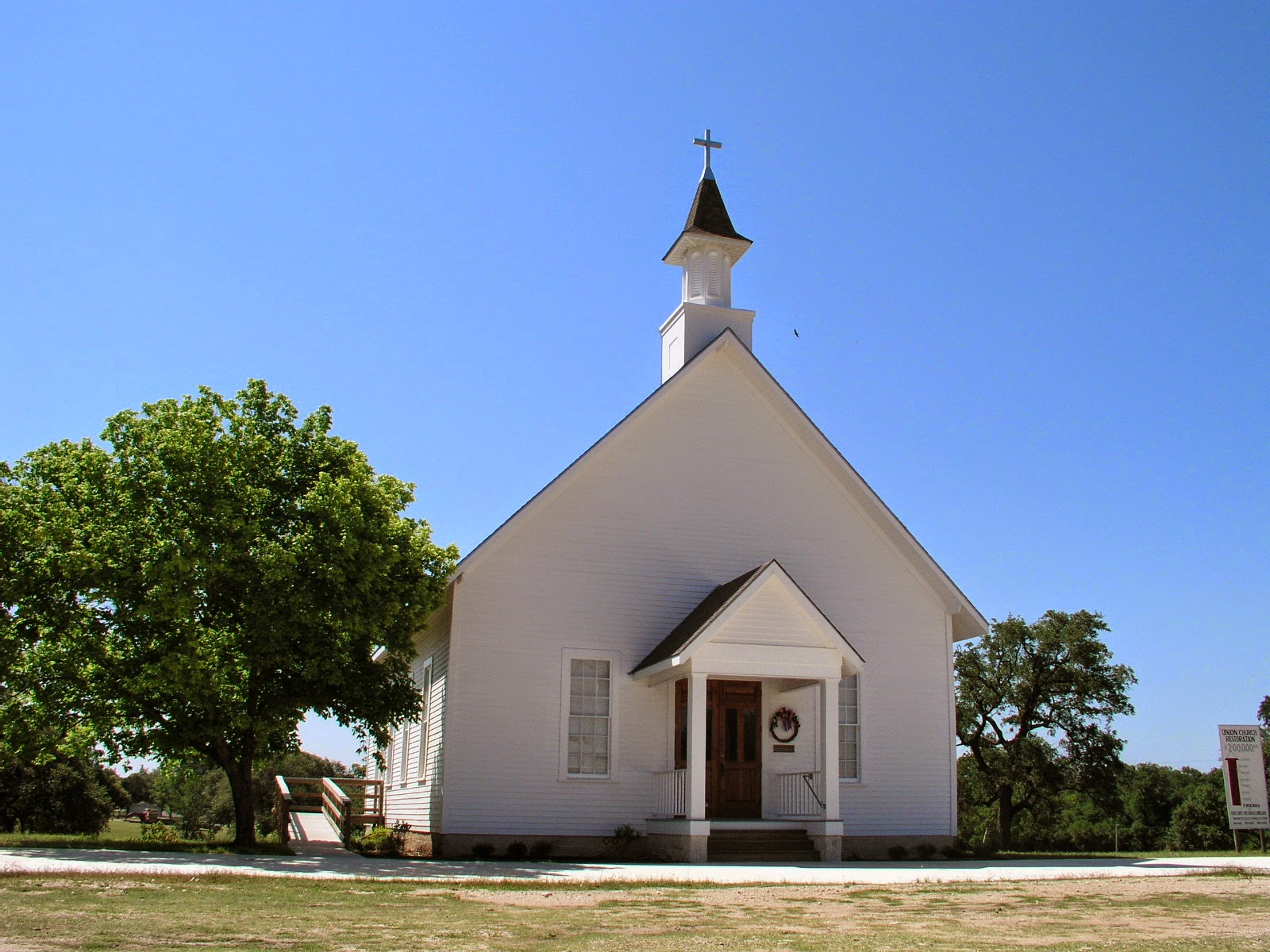
Union Church Building, 2002.
It's Easter time.  I decided to look in the old newspapers to find out how Easter was celebrated in Kerrville in the past. These are the highlights of Easter from about a century ago as reported in the local paper.

The earliest mention of Easter in the newspapers is in 1902 when shops were advertising Easter hats and bonnets. Few of us wear hats to church anymore, even at Easter; one custom seemingly gone with the wind.  However, secular customs common today were being mentioned in the newspapers by 1903--dyed eggs, baskets, and cards.
That year, the Kerrville Book Store offered "Easter Egg Dyes, Easter Cards, Easter Eggs, etc." The religious significance of the day was not ignored.  The Kerrville Mountain Sun of April 11, 1903, reported "Special Easter services at the Methodist church, Sunday, April 12.  Easter Music. Sermon on the resurrection by the Pastor". Oddly, this is the only mention that year of an Easter church service. There were probably others, but maybe they just didn't get their press releases in on time!

In 1905 the Famous (a retail store) offered Easter egg dyes with this comment: "Don't let the little ones pass Easter without rabbit nests and fancy eggs."  It appears by this time Easter  baskets were already a staple of Easter celebrations, although they were called "rabbit nests".

In 1906 there was only one Easter service in the city "on account of the illness of Rev. Jas. Drummond, pastor of the Presbyterian church, and the absence of Rev. J. T. King, of the Methodist church." "The Episcopal church was filled to its utmost capacity Sunday morning, and many were turned away for lack of room.  The floral decorations were exceedingly beautiful, the special music was delightful, and the sermon of Rector Galbraith was timely, interesting and helpful." I found it surprising that the other churches were unable to have even a lay preacher in the pulpit on Easter.  That wouldn't happen today! Someone would be there.

By 1909  worshippers could choose between services at the Methodist, Episcopal, Presbyterian, and Catholic churches.  The Union Church was still in use, and was being shared by the Christian Church and Lutherans.  They were not mentioned as holding Easter services, so perhaps this was the a off-week for both. (The Union Church originally was shared by four denominations, who took turns using the building.)

In 1913 a Sunday school class had an Easter egg hunt on the lawn of the teacher's home--the first such mention in the newspaper.

Aside from the Union Church, only one of those early Kerrville church buildings--the first First Presbyterian church building--reportedly remains today, but where?  Can anyone tell me?  A picture of the church from 1916, and a fairly recent photo are shown here.

Original First Presbyterian Church, ca 1916.

Original First Presbyterian as a residence.


I'll close with this quote from the Kerrville Mountain Sun for April 20, 1920: "Whether you are Methodist, Baptist, Presbyterian, Lutheran, Catholic or what not, Easter ought to be the one day in all the year when you would make a supreme effort to come to the Sunday morning worship of your church."  I hope you were there.
 

Sunday, March 30, 2014

Center Point Christian Church (Disciples of Christ)--Early Pastors

I am currently pulling together material to apply for an historic marker for the 1891 Center Point Christian Church, said to have been organized in 1879.  While I have no reason to doubt it, I would like to document that claim as well as verify the names and dates of service of the early pastors.  Today I'm going to share some of my research with you in the hopes some of my readers can help.  In the great tradition of "crowdsourcing" I've already had help from several parties from the church and Kerr Regional History Center, but we can use more.

An undated handwritten history of the church states that it was established in 1879 by Greenleaf Surber.  I have searched through the U.S. Federal Censuses from 1850 to 1940 and can find no one named Greenleaf Surber.  There are men named Greenleaf (think of the poet John Greenleaf Whittier), but none of them have a surname resembling Surber.

On June 20, 1883, one G. L. Surber officiated at the wedding of Mary Mattie Caldwell and John R. Storms.  This is doubtless the man we seek.  It seems to be the only Kerr County wedding he officiated at.
I think the "G. L." stands for Green Lee Surber (or possibly Greenville Lee), not Greenleaf Surber.
G. L. Surber was born near Somerset, Kentucky, August 13, 1837, to Adam and Jemima Mercer Surber. Jemima died 1875 and Adam 1879 in Center Point.  They are buried in Center Point Cemetery.
At the age of 15 G. L. became a Christian and began to prepare for ministry.  He was educated at Transylvania University.  After ordination he went as a missionary to Australia, serving six years near Melbourne.  In 1872 he returned to America and took a pastorship in Harrodsburg, Kentucky.  There he met his wife, Jennie Givens.  Their two children,  Hattie and Lee Elwood, were born in Kentucky, Hattie in Sept. 1876, and Lee in Nov. 1878.  I believe the reason he went to Texas was the death of his father. Adam Surber, along with much of his extended family, had left Kentucky for Texas in 1873.  Adam died March 3, 1879, and was buried in the Center Point Cemetery.  I think G. L. came to help take care of things and ended up staying a while, seeing a need for a church in Center Point and elsewhere in Texas.  According to his obituary, "He labored six years in Texas and strengthened the cause both at Waco and Dallas building a church at the latter place."  I found in a Google book snippet that he was preaching at a church in Dallas in 1881.  Whether it was a regular pulpit or a special event I can't tell. We do know he was in Texas in 1879 or early1880 when photos was taken of children Hattie and Lee (which can be seen on ancestry.com), and when he performed the wedding of Mary Mattie Caldwell and John R. Storms in 1883. My best guess is that he was in Texas from 1879 to 1885.

From Texas he returned to Harrodsburg, Kentucky (for about three years), then spent eight years in Lexington.  From there he went to Nashville, Tennessee, where he superintended the Southern Christian College for two years. In 1898 he, his wife, and children moved to Payette, Idaho, where he spent the rest of his life.

Based on the evidence, I think it is very probable that G. L. Surber established (or re-established) the Center Point Church.  He had a missionary heart and had established other churches.  I don't, however, think he was here full time. Or if he was, he didn't stay long.

There is then a twenty year gap. They may have been served by lay preachers.

The next pastor on record is Kilby Ferguson in 1904. The Christian Evangelist newspaper for July 7, 1904 reported "Kilby Ferguson is now the minister of the church at Centerpoint, Kerr Co., Texas, having removed from Louisiana."  And in the Oct 29, 1904, Kerrville Mountain Sun was the following item: "Elder Kilby Ferguson, minister of the Christian Church at Center Point, called on our office Monday.  Mr. Ferguson is to preach in Kerrville hereafter on each fourth Sunday at the Union Church. He preached here last Sunday and is evidently hopeful."

 After that was Brother Jonathan M. Streeter/Streater/Streator, who served from 1905 to 1914.  In the July 15, 1905, Mountain Sun he was referred to as the new pastor of the Christian church, and in the July 29 edition he was described as "an earnest and forceful talker and is sustaining his former reputation as one of the ablest preachers of West Virginia".

Rev. V. R. Stapp is the next preacher I find record of--in 1915.  I don't know how long he served.  After that was Brother Perry E. Hawkins,  who was the pastor at the Kerrville Church beginning in June 1924 but also "filled his regular appointment at Center Point" from June 1924-1926, possible longer; T. W. Storms 1929-?; and H. Ellis Thomas, 1938. Beginning in 1940 the records are much more complete.

I would appreciate hearing from anyone who can add to the record of these early pastors.
Again, their names and probable dates of service are:
G. L. Surber 1879-1885 (on and off)
?? 1885-1903
Kilby Ferguson, 1904-05
Jonathan M. Streetor, 1905-1914
R. V. Stapp  1915-??
Perry E. Hawkins, 1924-26 (possibly longer)
T. W. Storms 1929-??
H. Ellis Thomas 1938 (possibly later, but no later than 1939)


Tuesday, March 25, 2014

825 Earl Garrett Street


Things are not always they seem.  I've been trying to figure out when this house was built for a while.  The first mention of a building at 825 Earl Garrett Street is in an advertisement in the June 7, 1928, Kerrville Mountain Sun for needlework, "baby layettes a specialty."  Other ads beginning in 1929 offered rooms with light housekeeping.  The next mention is May 16, 1940, when Mrs. Della Sommers advertised she did dressmaking and needlework of all sorts. However, there is no property with this address listed in the 1936, 1940, or 1950 city directories.
Finally, I looked in the alphabetic name section of the 1940 city directory and have now figured out that the newspaper misprinted the address. In 1940 Della Sommers lived at 325 Earl Garrett--not 825!

So now let's explore the real history of this house.

According to the Kerrville Mountain Sun for June 14, 1918,"[a] deal was recently closed between Dr. A. A. Roberts and Tom J. Moore whereby Dr. Roberts purchased the residence property of Mr. Moore on Mountain Street." It seems he bought not just the residence property but additional land as well. It doesn't appear that Dr. Roberts ever lived on the property. He certainly never built a house on the vacant lot and there is no evidence he lived in the neighboring rental either.

The census shows some puzzling things. In 1930 the census taker recorded a house at 825 Earl Garrett rented by Jesse E. and Rose L. McCreary and one at 829 owned by Allie B. Burton. The 1930 Sanborn map shows houses at 821 and 829, so the census taker apparently made a mistake.   In 1940, just as in 1930, there was no house at 825.  There were families at 821 (Wm. Sullivan) and 829 (Allie B. Burton. )

 Dr. Alphonso A. Roberts was married twice, his second wife being Madona Roberts. He lived at 912 Water Street from 1892 to his death in 1948. The house is gone now. He was a director at First State Bank, served on the school board, and was a member of the Men's Club, a precursor to the Chamber of Commerce.
The June 1, 1966, Kerrville Mountain Sun described him this way: "He was a man, large of stature with heavy white hair and wore a beard, he had a kindly and gentle disposition and was often called "Santa Claus" by small children, who were seeing him for the first time.  He was a naturalist and was an authority on the native animals, flowers and trees of the area."

Dr. Roberts owned the land a long time, but after he died it changed hands several times in the next few years. His widow, on February 24, 1949, sold this property to Bradley and Gracey Mitchell for $10 "and other consideration". (His name appears as both Bradley Mitchell and Mitchell Bradley in the records. I think the surname is Mitchell.) They may have been the ones who erected the house, because the Mitchells sold the property to Jimmie M. and Hannah Sumner for $5300 on May 17, 1950.  The house turned over again in May 1951 when the Sumners sold to Leonard and Chloe Sharp, the sharps assuming the $4519.55 debt. (Leonard Sharp worked for the VA, receiving a 30 year pin in November 1959.)  Then in February 1952 the Sharps sold the house to R. L. Hardy and wife.
John D. and Helen Buckner, Kerrville Bus Company employees, owned the house from 1965-1972. It later had a series of tenants.


Friday, March 21, 2014

605 Earl Garrett Street

This Victorian at 605 Earl Garrett Street was erected by Banks B. Lowrance, a native of Mississippi.  I have been told this house was built in the 1890s, however Lowrance and his wife Linton did not purchase the land from I. N. Denton until May 4, 1904. They paid $45, a price that indicates a vacant lot. The house was probably built shortly after.

Banks Lowrance was a paperhanger.  On March 8, 1902, an ad ran in the Kerrville Mountain Sun "Lowrance and Goodwin.  Crackerjack Painters and Paperhangers.  Shop next to Dr. Palmer's Office." (Dr. Palmer's office was in the 600 block of Water Street.)
On July 26, 1902,  the newspaper reported "Lowrance & Goodwin left this week for the Shell Lowrance ranch on the Divide, where they will be engaged for the next two weeks painting Mr. Lowrance's house."

Politically active, Lowrance served as a city alderman 1903-1905. In 1920 he and Ben Smith were appointed judges for the municipal elections, then in 1926 he lost to Frank Moore in the race for Constable, County Precinct No. 1. That appears to have been his last foray into local politics.

His wife Mabel Linton Lowrance died of pneumonia died in 1932.
Her obituary from the February 4, 1932, Mountain Sun:
Pneumonia Fatal to Mrs. Banks Lowrance.
Following a brief illness of pneumonia, Mrs. Mable Linton Lowrance, 53, wife of Banks Lowrance, died Monday at the family home on Earl Garrett Street.
Funeral services were held Tuesday afternoon from the chapel of Smith Funeral Home, with Rev. Clift M. Epps, pastor of the First Methodist Church, officiating.  Burial was in Glen Rest Cemetery.
... Members of Miss Hardie Avera's Sunday School class served as flower girls.
... Mrs. Lowrance was a native of Kentucky, where she was born November 20, 1878; but she had lived in Kerrville much of her life.  ...
Surviving are her husband, Banks Lowrance; her mother, Mrs. Nyal Estell Davis; a son, Howard Lowrance; two daughters, Mrs. Elvie Morgan and Miss Amie Lee Lowrance; two sisters, three brothers.
I've never heard of flower girls at a funeral.  Does anyone know what they did?

In 1934 "Miss Amy B. Lowrance " was in a car wreck.  The Mountain Sun reported it this way:
Girl Victim of Wreck Improving.  Miss Amy B Lowrance, 19, daughter of B. B. Lowrance, Wednesday was reported to be making satisfactory improvement from injuries received in an automobile collision which occurred Wednesday night of last week.
Miss Lowrance, who is at the family home on Earl Garrett Street, suffered a compound fracture of the pelvic bone.  ... expected to recover.  [She was thrown from the car when it was hit from the rear.]  On E. Water Street near the Lucas Cafe.
Five year earlier her father had been struck by an automobile at the corner of Main and Earl Garrett, knocked down and badly bruised.  He was also taken to Secor Hospital, but his injuries were not as severe as his daughter's.

Banks Lowrance died in 1941 and is buried at Glen Rest.
From the January 9, 1941, Kerrville Times: 
Rites for B. B. Lowrance, 70, Held Friday.
Attack of Pneumonia Is Fatal to Pioneer Man Who Had Lived Here 53 Years. 
Mr. Lowrance passed away on New Year's Day at 5 p.m. at the family residence, 605 Earl Garrett Street.  He had been in failing health for several months and was stricken with pneumonia, resulting in his death within a few hours.
Funeral rites for Banks B. Lowrance, 70, a resident of this city for the past 53 years, were held Friday afternoon from the Smith Funeral Home chapel with Rev. J. R. Hilliard, pastor of the First Methodist Church, officiating.  Burial was in Glen Rest Cemetery.

Born April 17, 1870, at Burnsville, Miss., Mr. Lowrance, as a youth of 17, moved with his parents to Kerrville in 1887.  He grew to manhood in the city and until recent years followed his trade as a painter and paperhanger.  Soon after Kerrville was incorporated he served one term as an alderman in the '90's.  [correction: 1903-1905]
While he was of a retiring disposition, Mr. Lowrance took an interest in public affairs and was an advocate of community advancement.  ...
Surviving are two daughters, Mrs. Elvie Morgan and Miss Amy Lee Lowrance, and one son, Howard Lowrance, all of Kerrville.  The grandchildren also survive.
For a bit of local color, B. B. Lowrance is mentioned in a March 12, 1936,  Kerrville Times story.
The first water delivery in Kerrville was water hauled from the river to individual water barrels all over the city.
"When housewives were low on their supply, they would hang out a red flag as a signal for more water. Wash day was 'Trades Day' to the water haulers, and businesslike and civic-minded, they did everything in their power to sponsor cleanliness in the community.  B. B. Lowrance, an old-timer here who remembers the conditions, says that red flags hung out by housewives for rush orders looked more like a small-pox epidemic or a modern communist uprising than wash day."
B. B. Lowrance's heirs transferred the property to A. P. Allison "assuming all taxes" in 1941. Allison made repairs to the residence, rented it to Cecil Roe for a while, then sold it to Ruby Phillips in December 1943 for $2,000.  
She later sold it to Delia Whitehouse, who owned it until 1954. 
It has had a series of owners since and since 1992 has had commercial use, most recently as a bed and breakfast.

*****
If you have a house more than 50 years old that you would like me to research, please contact me at dgaudier at gmail dot com. 


Saturday, March 15, 2014

Pursley's Jitney Service


1915. Kerr County Historical Commission collection.
Here I am, off on a tangent again.  I saw this photo in the Kerr County Historical Commission collection and was curious as to where it was taken. I thought it might be on Water Street, but turns out it's not. I now know that most of the buildings in the photo no longer stand. They were in the 200 block of Mountain Street (now Earl Garrett Street) and have been replaced by the Baehre Building. The only building that still survives is the rock building, a corner of which is on the far right in the photo. That building is the Weston Building, home to Francisco's restaurant.

On the bottom of the photo is written  "Pursley's Service Line 'Kerrville's Pride'."
From March 1915 to June 1916 W. W. Pursley "The Man that Put 'Jitneys' in Kerrville. Fare is 10 cents.  Will do jitney service out of town." advertised that his office and station were "next to" the Post Office.  Research shows that it was near, not next to, the Post Office.  In June 1916 he sold the business to Henry James.
During this time period the Post Office was in the Masonic Building on Mountain Street so that is where I began looking for the jitney office location.

This photo appears to show two wood frame buildings and a brick building.

The Sanborn fire insurance map was an important help to figure this out. To the left is a clip from the 1916 Sanborn map showing the stretch of Mountain Street between the Masonic building at the top and the Weston building at the bottom.  In between are three small buildings between the vacant Masonic Building and the Weston Building. Two of the buildings were frame, the one between was an iron-clad frame building. So the one that appears to be brick in the photo is not brick. The  map shows that two of these buildings were jewelers. That would mean that the remaining small building, labeled "office" must be the jitney location. From the photo above it is clear that the one right next to the jitney service office is a jeweler. (Note the watch-shaped clock outside.)  The other is probably A. E. Self's jewelry store.  It closely matches other photos of Self's.

I have uploaded the photo to http://www.whatwasthere.com.  You can go there to see a comparison of the stretch in 1915 and today.  There are other Kerrville buildings there too.  To simplify the search, enter the zip code 78028 where it says "Where to."  Have fun!

Tuesday, March 11, 2014

417 Elm Street

1932. Kerr Regional History Center Collection.
This Tudor style bungalow at 417 Elm Street in Westland Addition with delightful eyebrows in the roof was built by William W. Miller, Jr.  The neighborhood began developing in May 1925 when the first lots were auctioned off. I wrote about Westland here.

This house was one of the earliest built in Westland.  On June 23, 1926, Kerrville Development Company sold this lot to Miller for $250.  The deed carried the provisions that the building must cost a minimum of $2,000 to build and finish, and that it was a whites-only community. The only non-whites who could live there had to live in separate servant quarters at the rear.  This racist provision was, of course, voided by law decades ago.

On August 7, 1934, W. W. Miller sold the house to W. E. and Marian Hahn for $3,400.  There was a requirement in the deed that Hahn must carry insurance against fire and tornado.  Within the year the Hahns moved to Baca County, Colorado, and sold the house to Mrs. J. E. (Rose) McCreary "feme sole" for $2,500.  "Feme sole" means "single woman" and indicated she had the right to own property in her own name.  In this case she was widowed.

In 1936 her daughter and grandson were living with her.

On November 4, 1939, her son-in-law and daughter, A. Edward Granes and Emma Pearl Granes, sold the adjoining vacant lot, no. 11, to Rose McCreary for $300 and moved to Cherry Street.  She died 1941 and is buried next to her husband at Glen Rest Cemetery.

While researching this house I came across the best, funniest obituary I've ever seen.
It appeared on the front page of the Kerrville Times August 4, 1938.
Parrot, Hero of San Francisco Fire, Dies at 41.
Closing with peaceful death an adventurous, action-filled life of 41 years, during which he survived fire, earthquake, and revolution, "Polly", a parrot owned by Mrs. J. E. McCreary, 417 Elm Street, toppled over backward in his cage Saturday.
["Polly"... what other name could you possibly give a parrot?!]
"Polly", a native of Mexico City, was a cosmopolite, globe-trotter and and accomplished linguist.  He could converse both in English and Spanish. 
Highpoint in the bird's career came on April 18, 1906, in San Francisco when the great earthquake and fire destroyed the city and brought death to hundreds.  When the first major shock was felt at 5 o'clock in the morning "Polly," with cries of "Help!", awakened the McCreary household.
"Polly" had traveled across the continent, from San Francisco to New York.  He had been to Cuba and returned often to his birthplace, Mexico, a country which he left several times during revolutions, escorted by bullets.
"Polly" was buried under a rose bush, and his spirit doubtless has gone to the parrot heaven where a cracker can always be had for the asking.

After Rose McCreary died the house was rented out.
In 1953 the house was advertised for rent as a 5-room house.  By October, 1955, it was a 6-room house, so this may indicate an addition on the house.

While doing renovations, the current owners discovered evidence of a fire in the past.  Digging around in the old newspapers brought up the Kerrville Mountain Sun, Dec. 23, 1964, report that sparks from a fireplace had ignited the shingle roof. A few weeks later a building permit was issued to W. A. Sullivan to make repairs estimated at $1,500.

The next owners were members of the Leinweber family. Mrs. Lena Pearl Leinweber died here in 1976 at the age of 80.  She had been living with her daughter and son-in-law, Mr. and Mrs. Cid Bluemel. Sometime after Pearl died her daughter Ferne Eckert retired, moved home to Kerrville from South Carolina, and lived in this house with her husband Clifford Herman Eckert. In 1988 she was one of seven candidates for Kerr County Commissioner, District 1, losing to Dr. Gordon Morgan.
The Eckerts eventually returned to Summerville, South Carolina, where he died 2002.

*****
If you have a house more than 50 years old that you would like me to research, please contact me at dgaudier at gmail dot com.