Saturday, March 23, 2013

1201 Broadway


There was a story in the March 21, 2013, Kerrville Daily Times about this house on Broadway. It has housed a series of restaurants over the last 35 years and is currently being renovated for a new sandwich shop.  When I took the photo the exterior was in the midst of being repainted. 
The house was described in the newspaper as being a 1930's era house. The house is actually older than that. It was occupied no later than 1920, and probably several years earlier.  
The 1924 Sanborn map shows this to have been a one story house at that time.  By 1930 a second-story had been added to the front of the house.  If you look at the bottom photo you can spot the original roof line behind the small tree.

It was the home of Mrs. Ella Smith, who arrived in Kerrville in 1916 and settled into this house. She, her daughter Lucile, and a son, Fred, came from Atlanta, Georgia, for Fred's health.  After Fred died, Mrs. Smith and Lucile remained in Kerrville. Lucile later married Lewis W. Eldridge.  The Smiths were living in this house at the time of the 1920 census.  Ella remained here until here death in 1941. Later her daughter, who continued to live here, rented out rooms. It was a residential property until 1976.

I am glad that this overlooked house has survived so long.  It is located on a stretch of road where other houses are being torn down for parking lots.


Thursday, March 21, 2013

Why isn't the Courthouse the center of downtown Kerrville?

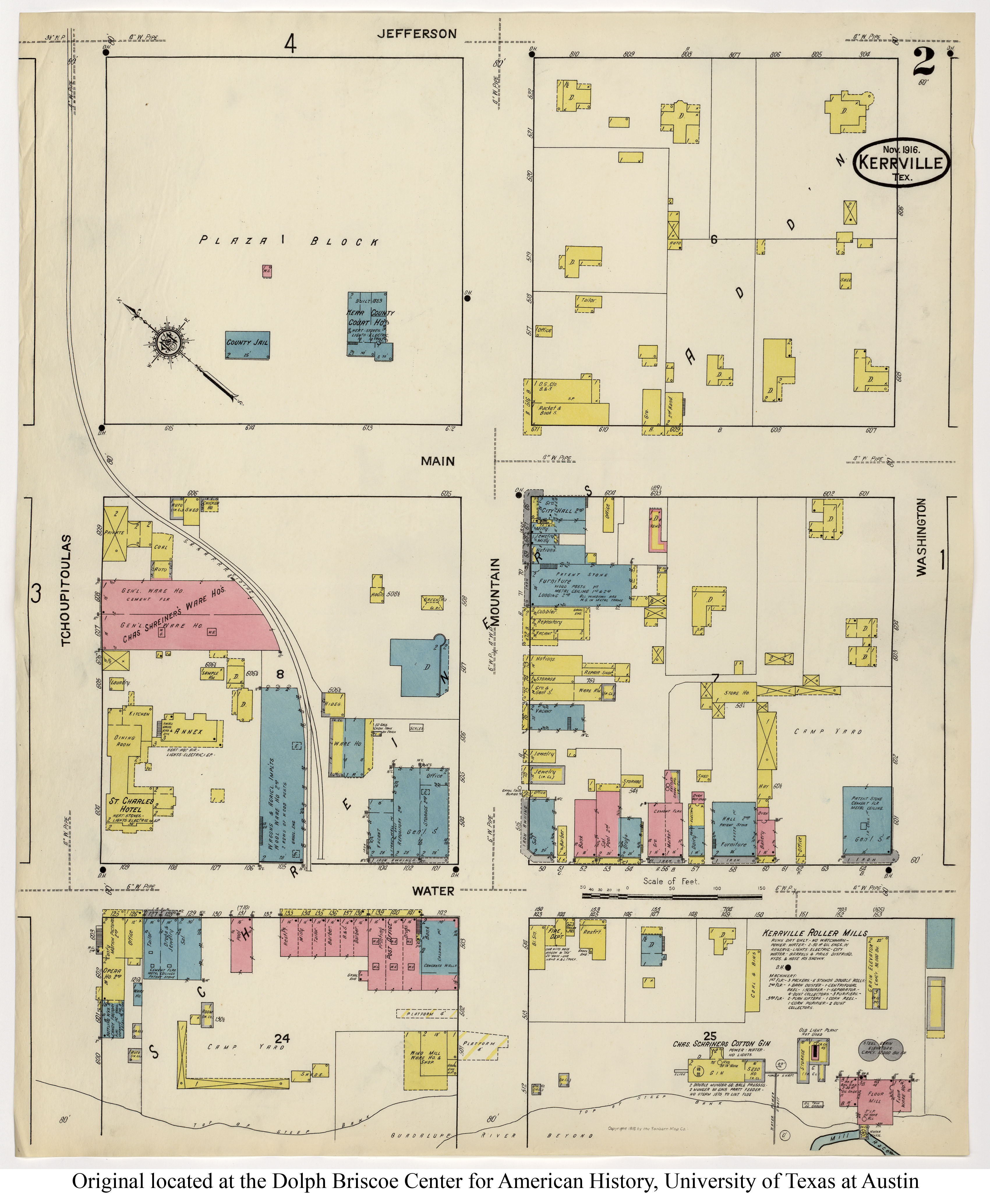
In most county seats in Texas and elsewhere, the courthouse is at the heart of the commercial district.  In many of these towns the courthouse sits in a green square and is surrounded on four sides by commercial and retail buildings. Generally, the citizens built a courthouse and businesses grew around it. Not so Kerrville. When you look at old city maps, you'll see that the county courthouse seems to sit on the edge of downtown. The greatest concentration of businesses is within one block of the Schreiner store. I've been pondering why this might be.  I was a bit slow figuring this out, but the answer is that Kerrville grew up around the Schreiner store. Charles Schreiner owned much of the land downtown and erected commercial buildings on many of the surrounding lots which he then rented out. This shrewd maneuver meant that virtually all those with business downtown had to pass by his store.  Others then erected their own business buildings nearby, drawing more people to this small area.  For years the principal business street was Water Street, where the Schreiner store is located, rather than Main Street where the courthouse is.  This Sanborn map of Kerrville in 1916 shows this clearly. The commercial development then was concentrated along Mountain Street (now known as Earl Garrett) and Water Street.  Even though today there are commercial properties surrounding the courthouse, the feeling is of parking lots on three sides and a row of professional offices on the remaining side. In all these years,there have been very few retail businesses in any of the buildings or lots facing the courthouse.  There were few a century ago and few today. Charles Schreiner's influence in how Kerrville developed continues today.

Saturday, March 16, 2013

221 FM 480, Center Point

This building at 221 FM 480  (San Antonio Street), Center Point, was erected in 1929 by Arno Schwethelm. It adjoins the Center Point Mercantile Building.
In July 1928, Arno Schwethelm purchased eight lots on San Antonio Street belonging to the bankrupt Center Point Mercantile.  According to the July 12, 1928,  Kerrville Mountain Sun the properties included "the former Center Point Mercantile Co., the Drug Store, Post Office, Motion Picture Theatre, Oil House and several other minor concerns.  Mr. Schwethelm stated that for the present he would not actively manage any of these interests but lease the properties."
A few months later, on January 17, 1929, the newspaper reported that Schwethelm was "planning to tear away the old drug store building and replace it with a fireproof structure."
It was in late April of that year that Vernon Powell, who had purchased the Center Point butcher shop, announced he was moving to the new building just being finished by Arno Schwethelm on "Main Street", i.e. this building.  His was the first business in the building, occupying one section.  I do not know what business occupied the other part of the building.  Any information about the early history of this building is welcome.


Wednesday, March 13, 2013

1013 Main Street


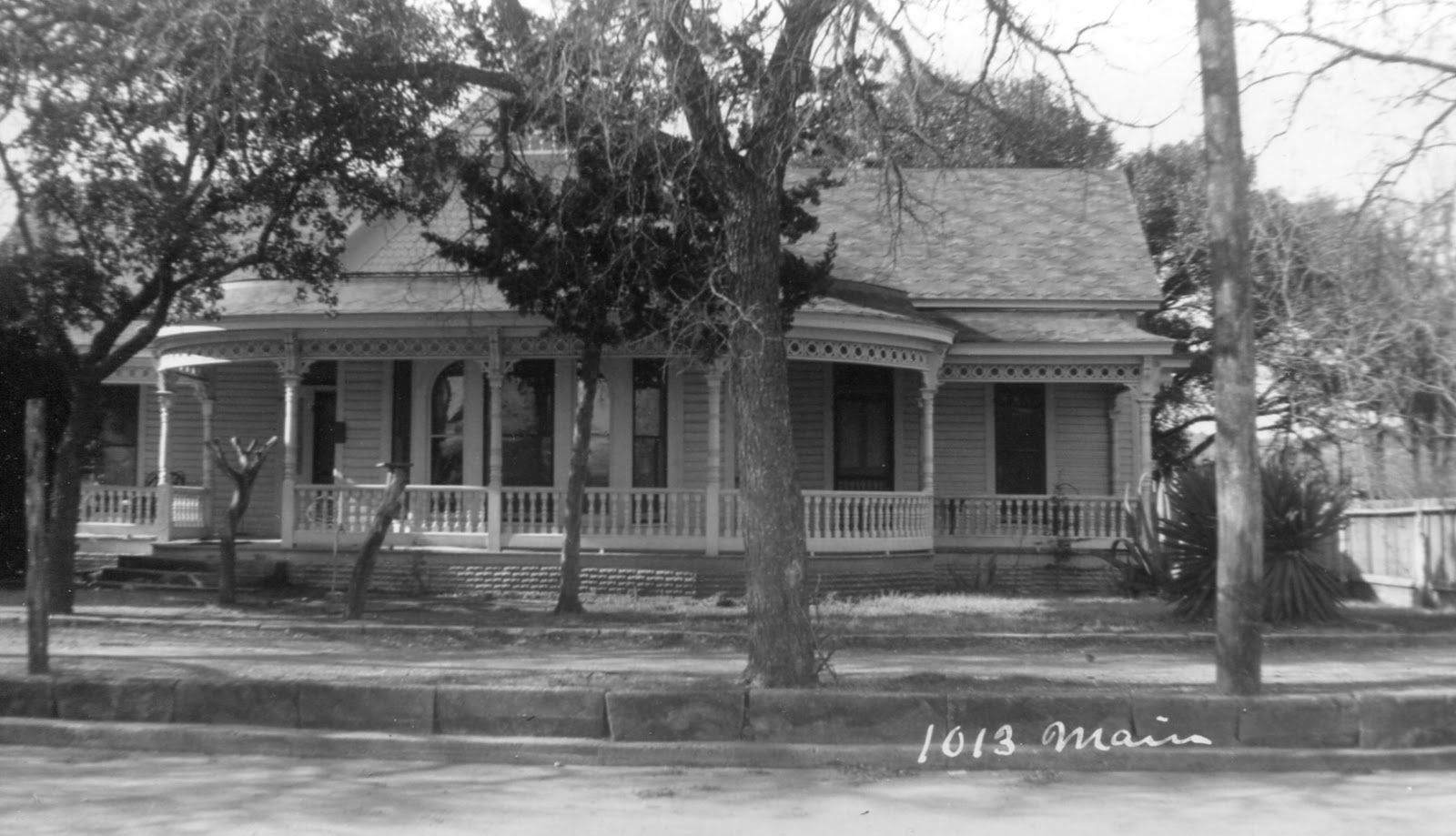
This Victorian house at 1013 Main Street, now home to Creations, a quilters' supply shop, was the home of William Henry and Florence Rawson. Reported to date to 1895, it may be slightly older.
The 1899 sketch below shows a much more heavily decorated house that we have today.
Rawson was a druggist and owner of Rawson Drug Store.  He also served two terms as mayor of Kerrville from 1896-1900.
 

Rawson came to Kerrville in 1890 seeking the same thing that so many early settlers sought--improved health. His health being restored, he opened a pharmacy here. Rawson's Drug Store building on Water Street stands today and is known as the Davis Building. I wrote about it here  http://kerrhistory.blogspot.com/2012/05/davis-building.html
ca 1932

On June 16, 1890, W. H. Rawson purchased 4 building lots from James A. Tivy for $450 ($50 cash, and a $400 note).  Two of those lots were on Main Street, the other two adjoining lots were on Live Oak Street.  The note was paid and the lien released by Tivy on November 12, 1891. The Rawsons probably built the house shortly after that. 
ca 1899
In 1899 the city of Kerrville valued the property at $850; the next year it was valued at $1350. The  most reasonable explanation for the increase is that an addition was put on.
Florence died  in 1914.  W. H. Rawson continued to reside here until he died in April 1931. They are buried at Glen Rest Cemetery.

Saturday, March 9, 2013

Lange's Mill, Gillespie County


Threadgill Creek
A friend and I made a day trip to Mason and did some sightseeing on the way. This lovely historic mill is near Doss in Gillespie County. It sits at a particularly picturesque spot on Threadgill Creek where Lange's Mill Road crosses.
A large water wheel, now gone, provided the power to grind grain for local settlers.
The mill and a distillery were established in 1849 by brothers John E. and Thomas C. Doss. They ran the mill for 15 years before selling it in 1964 to August Steiness who tore down the distillery and expanded the capacity of the mill. In 1866 Steiness' widow sold the mill to William F. Lange. The Lange family ran the mill another two decades.
A state historic marker was placed here in 1936.


Wednesday, March 6, 2013

Hilda United Methodist Church, Mason County


On a day trip to Mason an unusual contemporary looking white steeple just off CR 783 caught our attention, so we turned off and stopped at the Hilda United Methodist Church in Mason County. It turned out the steeple wasn't contemporary at all, but was original to the 110 year old church building.
Originally known as Bethel Methodist Episcopal Church, the church was erected of local rock in 1862.  It was torn down and rebuilt using the same rock in 1902.  Three different colors of rock are apparent in the building.  The walls are of brown rock, the windows outlined in a different shade of brown, and the quoins in white limestone.

Also on the large church property are a cemetery, the original parsonage, and two esshousen (eating houses) that date back to the time when families came and spent all day Sunday at church, using these small buildings to gather and eat a meal between the morning and evening worship services.

The community of Hilda seems to consist entirely of this church and a few houses.  Unfortunately I didn't review my photos before I left.  As a result, I don't have a single photo that includes the top of the steeple and the church in the same picture. Oh well, another time.  I did, however, manage to get some decent photos of the interior. The pews are quite lovely, with distinctive bullseye designs on the arms.

This building has been a Recorded Texas Landmark since 1965.

Saturday, March 2, 2013

Mount Olive Baptist Church


On Sunday, February 24, 2013, the Mount Olive Baptist Church historical marker was unveiled. Located at 121 West McFarland Drive, Mount Olive is one of two historically African-American churches in Kerrville, the other being Barnett Chapel Methodist Church. The church was organized in September 1902 and first met in a small schoolhouse on Paschal Street.  The first structure on this location was a simple frame building with no furnishings.  Members brought chairs from home for services.  After a piano was given to the church, Miss Deloris Gipson would drive from Victoria on the weekends to play for worship services on Sunday.
For many years the congregation owned the building, but not the land it sat on.  Then in April 1946 Riley C. Eggleston sold lots 13 and 14 in Parson's Addition to the church for $10 so it was at that time they finally owned the land as well as the building.
In 1961 the frame building was remodeled.  The church was extended, including the two entry areas, and a brick facade added, bringing it close to the appearance today.
In May 1990 lightning struck the steeple, causing a fire that heavily damaged the roof and attic of the church. The members met for several weeks at the Dietert Claim Center on Jefferson Street, and then in the church's fellowship hall until all the repairs could be completed.
Today a more diverse membership continues the community outreach the church has been known for over the years.