Wednesday, December 16, 2015

Motley Hills


The developer of Motley Hills was Delmar H. Motley. This subdivision was developed on land purchased from Schreiner Institute (now Schreiner University) in 1961. The first record of the sale of a lot in Motley Hills is Citriana Development Co. to William C. Kenthick? Jr., and wife who purchased lot 3 in block M of Motley Hills Subdivision. This was reported on the February 7, 1962, Kerrville Mountain Sun. However it was a week later that the Mountain Sun reported the City Council had reviewed the plats.

In October 1963 a rather nice spec house in Motley Hills was advertised for sale for $13,900.  It featured three bedrooms, two tile baths, electric kitchen, central heat and air conditioned, double garage, laundry room, and insulated! Was insulation an unusual feature in a house?

The February 9, 1961, Kerrville Mountain Sun had the following item:
Meeker Land Sold For Subdivision
Delmar Motley of McAllen has purchased nine acres from Burton Meeker near the National Guard Armory and plans to start a subdivision of low cost housing.  Motley said the homes will have brick veneer, have two and three bedrooms, and will sell for less than $10,000.
Then on February 23, 1961,  the following item appeared in the Mountain Sun:
68 Acres Tract Sold To Motley By S. I. Board.
Sale of 68 acres of land to D. H. Motley was announced this week by Dr. Andrew Edington, president of Schreiner Institute.  The land, which lies along Travis Street, adjoining the city limits, was sold for approximately $500 an acre.
Motley, who is from McAllen, plans to start a subdivision on the tract this week end, priced from $8,000 and up.  Motley had previously talked about buying some land from Burton Meeker for the subdivision.

To learn about other Kerrville subdivisions, go here.


Sunday, November 29, 2015

Starkey Manor

Starkey Manor Subdivision was first advertised in the October 10, 1946.  "Exclusive Home Sites--Highly Restricted." Tracts varied from 1 1/4 to 3 1/2 acres each and were priced from $1100 to $1500 an acre.  Interestingly, each lot could have two homes on it.  City water and paved streets were guaranteed, as well as electricity and telephone service. Some of the advertised restrictions included building restrictions "set at appropriate financial levels" and private residential construction. 

It appears the very first lot sold was to Paul J. Broyles and his wife in September of that year.

In the fall of 1947 3 bedroom, 2 bath ranch-style houses were being constructed along Methodist Encampment Road as spec houses selling for about $13,000.

Starkey Elementary, built in "outer Westland", was built to serve the growing population in the western suburbs.  It welcomed its first students in September 1949. In the May 26, 1949 Kerrville Mountain Sun, it was described as a seven room school with one teacher in each class to serve grades one through six. One teacher would act as principal, one would also teach music. It was thought first grade would probably go morning only, the other students having all day schedules.
The Mountain Sun of August 11, 1949, reported the first teachers were: Dan Price, head teacher and mathematics; Mrs. Henry C. Hahn, first grade; Miss Yetive Watkins, second grade; Mrs. Roy Littlefield, Jr., third grade; Miss Betty Jo Brown, fourth grade; Mrs. A. F. Forvilly, fifth grade, and Miss Dorothy Staudt, music. No 6th grade teacher was named--but there must have been one because the 6th grade is mention in other news stories.  Due to segregation, Starkey served only the white elementary students living west of Town Creek--166 total the first year. Those east of Town Creek, 646 in all, went to Tivy Elementary.
Those seven classrooms were insufficient. One year later a contract was let for a seven room addition to Starkey, doubling its capacity. 

To learn about other Kerrville subdivisions, go here.

Friday, November 27, 2015

Kerrville Subdivisions


Some time back I began compiling a list of Kerrville Subdivisions with their dates of creation and wrote about some.  I've compiled a list of subdivisions in Kerrville created no less than 50 years ago. This is probably not  a complete list.  I welcome additions. Some subdivisions were developed over several years.  I am looking for the dates of zoning approval or date of first houses in development.

Hillcrest September 1922
Buena Vista 1923 (includes 700 block of Wheless, Myrta, Moore)
B. C. Richards First Addition 1924
Methodist Encampment 1924
Oak Park by September 1924
Henry Wallace Addition 1925, No. 2 October 1945
Westland Place auctioned May 7, 1925  (738 lots)
Westland Hills sales kicked off  Jan 1, 1926
Valley View Addition 1926
Oak Hill Addition 1928 (includes site of former Mayor Remschel home)
Richards Park Addition November 1941
Legion Heights October 1945
Hill Top Estate  September 1946  (George H. and Mrs. Mary Miers granted permission to plat 22.65 acres)
Starkey Manor  October 1946 (Mrs. Pattie Starkey and A. L. Starkey Jr. to plat 123.63 acres.)
Blue Bell Hills October 1947
Hal-Bart  October 1947
Highlands Addition 1949
Guadalupe Heights August 1950
Richardson Addition 1951 (includes a seven block area adjoining Westland and the Hal-Bart addition) No. 3 1962
Murray Heights  September 1961
Motley Hills 1962 (section 2 1966)
Price Addition April 1962
Fawn Valley Estates April 1962 (on Harper Road)
College Cove 1963
Mills-Miller Subdivision ??
Hazy Hills 1964
Royal Oaks 1965
Colonial Manor 1967
Shady Grove 1967
Riverhill 1967 (originally known as Tamanaco Estates, then Forrest Hills)

Saturday, August 22, 2015

Bushwhack Creek

Turtle Creek rises about 18 miles southwest of Kerrville and feeds into the Guadalupe south of the airport.  One of its major tributaries is Bushwhack Creek, whose name comes from an event during the Civil War in 1862.
When the war broke out, many Germans, who were only recently arrived, felt loyal to their new country, and did not support slavery.  Major Frederick "Fritz" Tegener and others were part of a Union Loyal League, organized in 1861with several hundred male unionists.
In 1862 Tegener received information that the Hill Country counties of Gillespie, Kendall, Kerr, Edwards, and Kimble were considered to be in open rebellion against the Confederacy and that Confederate forces were en route to the area.  Tegener was appointed leader of a group of Unionists that attempted to make their way to Mexico.  About 68 men organized and camped along a tributary of Turtle Creek while waiting for others to join them.  They camped several days, then started their fatal march to Mexico.  They were ambushed and massacred by a group of Confederate soldiers on the banks of the Nueces River. The monument "Treue der Union" in Comfort commemorates this event.

The above-mentioned tributary of Turtle Creek is Bushwhack Creek.  This meeting point, which is on a private ranch, deserves an historical marker. 

Wednesday, March 25, 2015

Sears-Roebuck Kit Houses

Last week I did a program for the Kerr County Historical Commission on the topic of kit houses in Kerr County, focusing on the Sear-Roebuck & Co. Modern Homes kit houses.
I was told some time back that there are a dozen in Kerrville.  No one I talked to had a full list, so I have not located all of them yet, but here are some.  The first group are all along Earl Garrett Street.
501 Earl Garrett Street
608 Earl Garrett Street
609 Earl Garrett Street  (The Crescent style, one of the most popular Sears houses.)
612 Earl Garrett Street
There is another one on Earl Garrett that is owned by the H.E. Butt Foundation.  I have to confirm the address before linking.

One additional possible Sears house is the house at
816 Earl Garrett Street   Note this is a POSSIBLE kit houses.  I am still working on this.

There is a house near the corner of Harper Road (700 block) and Holdsworth Drive (400 block) that I have been told is a Sears house.  It was once the home of Jeanne Slobod (now deceased).
 
For a few years Sears offered home mortgages.   Researching for this program, I went to the Kerr County Courthouse to look for mortgages recorded in the deed records and discovered two.
Both of these properties were built outside the city of Kerrville.

One of them,  in 1928, was for a house at the Kerrville Sanatorium, located about 2 1/2 miles from Kerrville on the Fredericksburg Road.  We do not know if that house is still standing, and if so, if it is at the original location or of it was moved.  The city limits were different then. "Two and a half miles from Kerrville" would place this particular sanatorium at about I-10 and Sidney Baker Street today.

The other house with a Sears mortgage, located in the 400 block of China Street in Center Point, it was built by Benjamin and Mary Mattingly in 1931 and was covered by local rock.  The family story is that the rock is river rock from the Guadalupe, but the rock is reddish in color, not typically found around Center Point, so it may have been hauled in.

If you can add to any of this, pleased comment below, or email me at dgaudier at gmail.com


Saturday, September 27, 2014

The Carriage House behind 425 Water Street

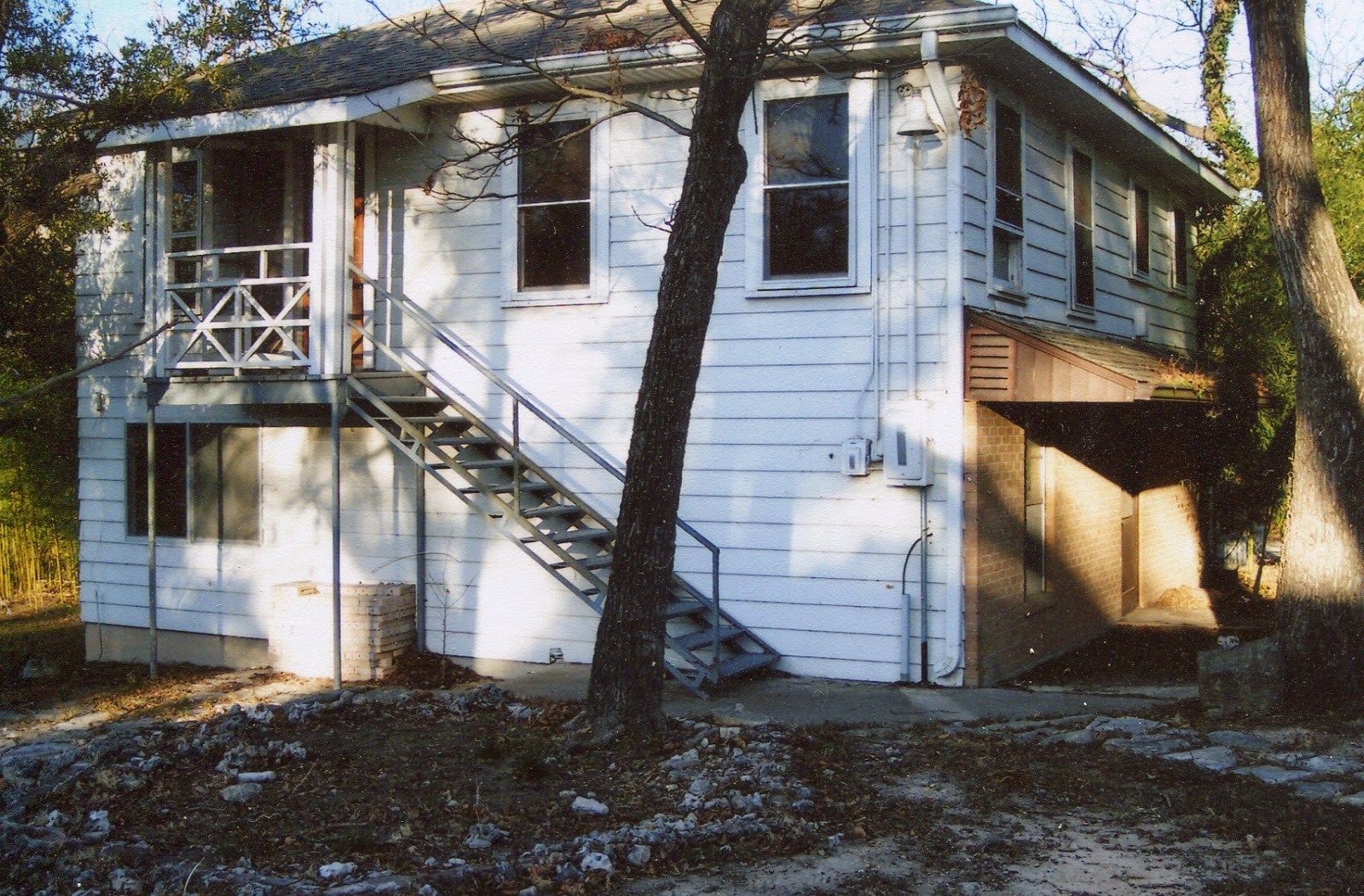
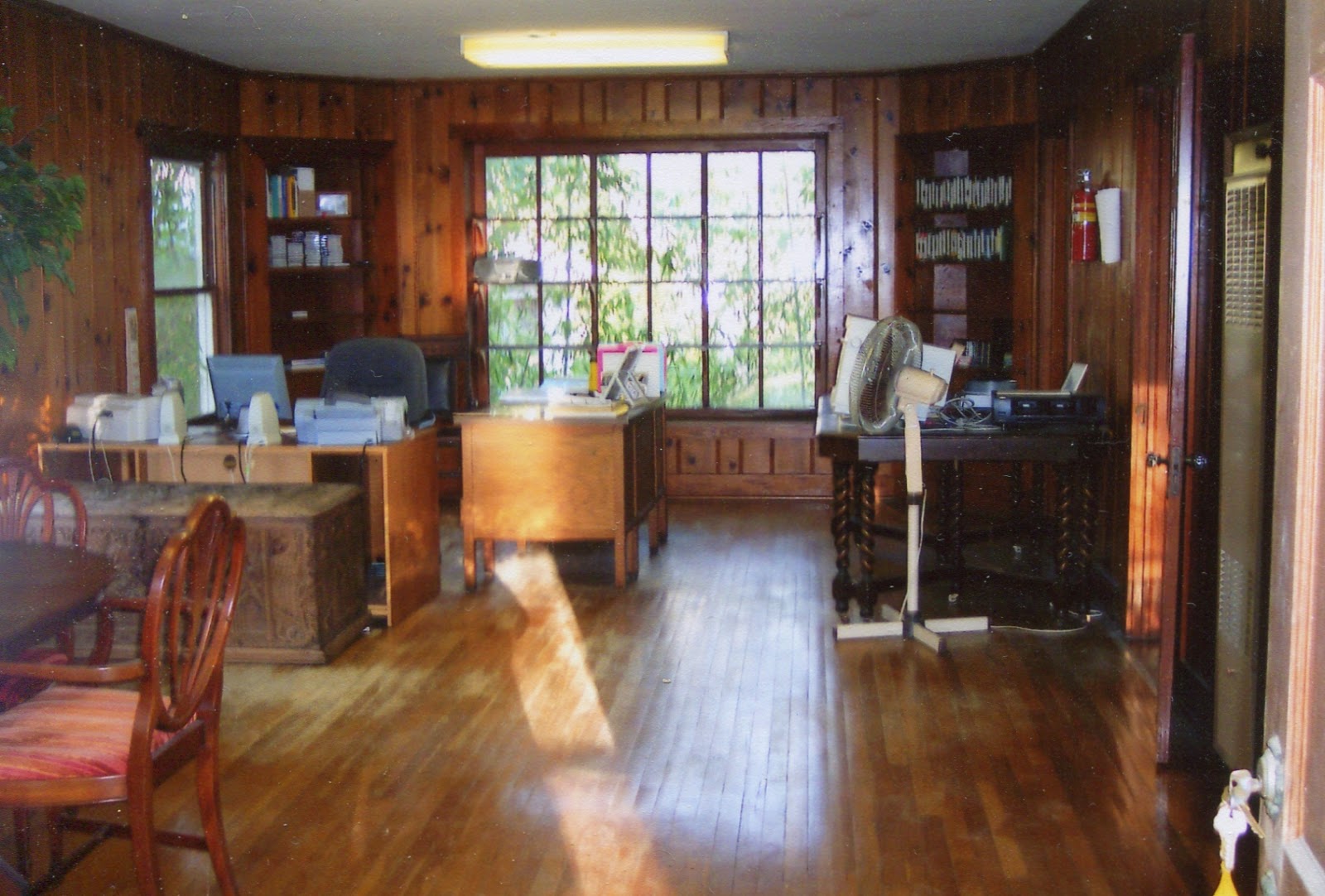
Until June of this year a small two-story building known as "The Carriage House" sat behind the Kerr Regional History Center at 425 Water Street. That small building is probably as old as the house in front, erected in 1914. This summer the building was removed as part of a "campus improvement" plan.The lower floor had suffered considerable water damage, but the upper floor had beautiful, fine-quality woodwork well worth keeping.
The Carriage House
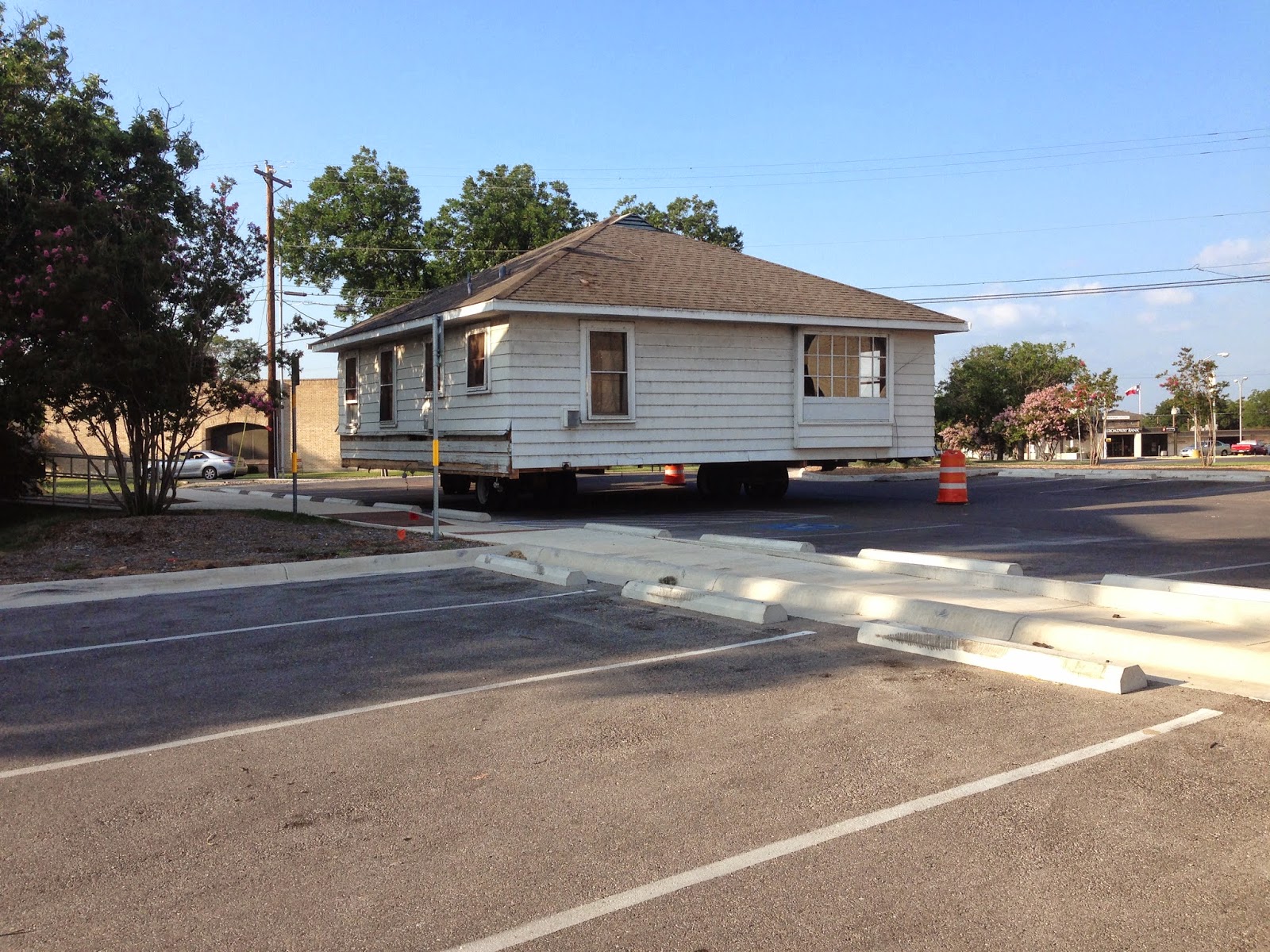
The lower floor was removed and the upper floor, which was a self-contained apartment, moved to a lot in Ingram, the new owner hoping to sell it to someone who appreciated the quality of the building and materials.

Many people have talked about the beautiful woodwork on the second floor.  This week I was loaned some photos of the building taken several years ago.
It was indeed beautiful inside. I commend the purchaser for removing the house instead of tearing it down.


Prepared for moving
The interior woodwork

Another view of the woodwork

Wednesday, September 10, 2014

Kerrville Regional History Center No Longer Managed by Kerrville Genealogical Society

This week the City of Kerrville ended the long relationship between the Kerrville Genealogical Society and the Kerr Regional History Center.  Here is the press release from the KGS concerning that.

For immediate release – Sept 8, 2014 – Kerrville, Texas

Kerrville Genealogical Society To No Longer Assist in Managing the Kerr Regional History Center
       
For more than 40 years, the Kerrville Genealogical Society has partnered with the Butt-Holdsworth Memorial Library to provide genealogical research assistance to the community.  Since 2003, when the Kerr Regional History Center moved to the historic Scott Schreiner house adjacent to the library, the Kerrville Genealogical Society and a group of other volunteers have cared for the research materials housed in the History Center and have provided thousands of hours of free assistance to members of the public researching local and regional history.

On Sept. 8, 2014, in a meeting attended by the board of the Kerrville Genealogical Society, City Manager Todd Parton, Mayor Jack Pratt , City Councilman Gary Stork, Library Director Laura Bechtel, and Director of General Operations Kim Meismer, Parton announced that the Kerrville Genealogical Society was to no longer provide assistance in managing the Kerr Regional History Center.  Volunteers who wish to continue volunteering at the History Center must now go through the same process library volunteers do.

We believe the deteriorating relationship between the city and the board of the Kerrville Genealogical Society began in 2011 when the  Kerrville Genealogical Society discovered  that money from a trust fund that had been intended to benefit the History Center was being using incorrectly by the city. This error was initially corrected by the city when it was brought to their attention, but it is unclear whether the trust fund money is currently being properly used. A formal audit would clear this up.

The city has now decided that city assets should be managed by city staff. The city says it plans to keep the building open for the same hours it was open before, which would be 18 hours a week. However, this  potentially means 36 hours a week of additional paid staff time because, for security, at least two persons need to be available at the History Center when it is open.  This expense will have to be funded by city taxpayers.  In the past, volunteers kept the building open at no charge.

The Kerrville Genealogical Society is saddened by this move by the city of Kerrville. The Kerrville Genealogical Society has over the years spent thousands of dollars of its own money garnered from public donations purchasing such things as a microfilm reader, a refrigerator, and a microwave in the staff lounge, file boxes, books, and more.  Until the recent building renovations, required due to recently discovered structural problems, the city had spent virtually nothing on maintaining the building or its amenities. There seemed to be a lack of interest in the building. History Center volunteers cleaned the building, organized and indexed the collection of documents, and provided thousands of unpaid hours of volunteer time to assist the public. 

The Kerrville Genealogical Society will be moving its assets and materials from the History Center soon. Despite this, the Kerrville Genealogical Society will continue to offer high quality programs and a newsletter, and will be looking for a new home for its materials. In the meantime, we will do our best to handle genealogical and historical inquiries by mail or email. 

We may be contacted at  kerrvillegensoc@gmail.com